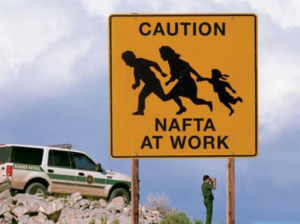
 Anyone who was around in the early 1990’s may remember the mantra of modern globalization was that centralized markets were bad and decentralized markets were good. Fast forward to 2016 and blockchain technology: centralized ledgers are bad decentralized ledgers are good. Does this sound familiar? Blockchain and NAFTA may have a lot in common. The good news is that perhaps this new world is not quite as uncharted as it now appears.
Coinciding with the end of the Cold War, we can now look back at NAFTA as the Big Bang of modern globalization. The supporting calculus is credited largely to the ‘theory’ of Comparative Advantage; an economic thesis referring to the ability of any given economic actor to produce goods and services at a lower opportunity cost than other economic actors. The idea first appeared in 1817 in a book by English economist David Ricardo, “Principles of Political Economy and Taxation” David Recardo’s ideas still serve as the logical basis of international trade. The efficiency of this economic model were at the time, and still are, indisputable.
Further back, the 15th Century concept of Laissez-Faire is an economic system in which transactions between private parties are free from government interference. Meanwhile, the “invisible hand” was a term first used by Adam Smith to describe the unintended social benefits of individual actions. These ideas formed the cornerstones of modern Capitalism – the decentralization movement of a prior era. Indeed, Capitalism solved a great many human problems while arguably ushering into existence new, and possibly more perilous problems such mass political instability, financial crises, and even climate change. Now, the advent of bitcoin claims to solve many of these problems. This begs the question, what new problems will be created after 25 years of blockchain technology?
More importantly, perhaps this connection to a large body of precedence (if we are clever) can guide us to a different set of outcomes than prior decentralization technologies. This is an important and timely question given the blockchain technology, due to the Network Effect, is exponentially more powerful than the relatively linear Law of Comparative Advantage.
Lessons Learned
I was involved with developing standards for the mutual recognition of engineering professionals between US, Canada, and Mexico back in 1993-1996. What made NAFTA different, and hence “modern”, was an inclusion of free trade in services sector. These included financial services like banking and insurance as well as professional service providers from engineers to librarians. Essentially NAFTA attempted to treat intangible value directly as a tangible object for international trade. Still a problem yet to be solved.
At the time however, the mutual recognition of professional engineers was controversial and divisive. The US engineers were fearful that they would lose their high paying jobs to cheap Mexican engineers, whose salaries were about 1/10 the US engineering salary. A “giant sucking sound” was the popular phrase coined by a billionaire presidential candidate at the time. The fear was made very real for many people, not unlike the immigration debate that continues to rage today.
I saw something different.
In Mexico, I saw an entire nation – an entire continent – that needed everything that US engineers create. Mexico, Central America, and South America needed roads, bridges, structures, water, energy, and every manner of infrastructure upon which free markets utterly depend. Since NAFTA also liberalized trade in financial services, that meant that economic development could be financed at low cost of capital. In my youthful idealism, I felt that the opportunities for engineers from all countries was beyond extraordinary – to me, it was specifically the rising tide of basic infrastructure that would float all boats. Unfortunately, this opportunity was woefully squandered. Let me explain.
In the US, and many developed countries, the professional engineering licensure laws assure transparency, consensus, and economic incentives that rewards high integrity rather than low integrity among engineers and contractors who carry such licensure. When the PE stamp is indelibly attached to the project plans, the asset that is described by those plans is held in suspension on the balance sheet during the design and construction phase. This span of time is when the highest monetary risks and technical risks occurs. Insurance companies depend heavily on engineers to verify the design, materials, processes, components, chronological order and performance of all components of the systems that they insure. Where risk can be transferred to insurance, the cost of capital can be minimized.
The problem with the NAFTA Mutual Recognition Standards for engineers was that the three negotiating bodies for the US, Canada, and Mexico failed to reach an agreement over reciprocity of the other member’s licensure model and instead defaulted to the highest common denominator which fell far short of practicality while also failing to meet the conditions of insurability, especially for Mexico. As such, infrastructure projects could not be financed for lack of licensed engineers in the relevant NAFTA jurisdictions. This was not for lack of money because NAFTA also liberated access to financial services – but for lack of insurance. Without a tip-to-toe insurance presence, Latin American economies continue to experience difficulties in bridging the capitalization gap. Innocent people suffer.
Many trade agreement that followed NAFTA would go on to include free trade in services, and also inherit this flaw capitalization of infrastructure for lack of Global Engineers. Unfortunately, mutual recognition of engineers would be stopped cold at the borders for lack of insurance. Many of the problems associated with globalization today, in my opinion, can be attributed to the failure of the NAFTA Mutual Recognition Document for Professional Engineers. We have an opportunity to correct this flaw and it is imperative that we do so.
To centralize, decentralize, or re-centralize.
While the economic theories of decentralization are sound, the intended outcome has been elusive. Instead of converting from centralized serfdom to the invisible hand of freedom, we keep inventing new forms of re-centralization where one centralized system is traded for another under the auspice of decentralization! The danger is that blockchain technology will not reach its potential of economic freedom for all, rather, it will simply become another form of mechanization that replaces people with machines. A decentralized solution will require the integration of machines with people. That means we need to augment human capacity not “surplus” it.
Blockchain technology replaces some – but not all – of the decisions that a human administrator makes. It will be important to look at bureaucratic processes and accurately discern what can go to a blockchain and what must remain in human judgement. The current markers of re-centralization include so-called permissioned ledgers to replace back office workers. Permissioned by whom? A centralized authority? The running joke in the cryptocurrency space is that any effort to control a decentralized system quickly cancels out the advantages of having one in the first place. Re-centralization is dangerous.
Instead, the integration of humans and blockchains should take a hybrid approach where humans serve as adjudicators to the blockchain machinery pointing smart contracts toward the intended outcome at specific points of risk transfer. Eventually, a means to decentralize the human adjudicators will be required so that they cannot be corrupted. One such solution is proposed by The Ingenesist Project. It is called Curiosumé and it converts a CV to cryptography so that holders can lock contracts to a blockchain quasi-anonymously.
The consortium between engineering and insurance is a critical development in the current evolution in blockchain technology and is required to break the cycle of recentralization by expanding the insurance capacity of our financial system to a fundamental storage of value – public infrastructure. We need to learn how to convert existing engineering and construction contracts into blockchain adjudicated smart contracts. We need to figure out how to decentralize the adjudicators in a fault tolerant system that cannot be easily corrupted, thus providing for optimal allocation of public and natural resources. Then we need to expand the adjudication system to all other service professionals who also serve the needs of our human markets. The resulting cryptocurrency will have intrinsic properties that people will be willing to trade. In this manner, the cost of capital will be lowest for the most proper allocation of resources required by an increasingly crowded planet.
(Adapted from; Insurance: The Highest and Best Use of Blockchain Technology, D.Robles, July 2016 National Center for Insurance Policy and Research / National Association of Insurance Commissioners Newsletter: http://www.naic.org/cipr_newsletter_archive/vol19_blockchain.pdf)