
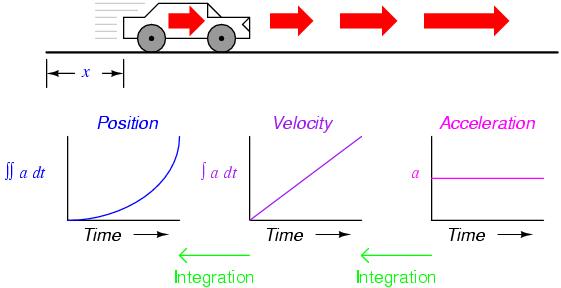
The WIKiD Tool algorithm provides a mathematical framework for analyzing dynamic data related to social interactions in a network and memorialized on a Blockchain. This example uses an analogy to the position / velocity / acceleration equations that some people may remember from their school days.
These types of relationships are important for measuring things like innovation. Ask any VC for a definition of Innovation and they’ll probably say “I’ll know it when I see it” or “it’s a good idea with an economic outcome”. Neither of these things are measurable until long after the innovation occurs which is not practical. However, if we could measure something that is closely related (correlates) with innovation, perhaps we could use that to measure the thing we can’t see.
A similar thing happens on Wall street – how do you measure consumer confidence? Financial analysts noticed that the price of some commodities track closely with consumer confidence so they use that as a proxy for the thing they cannot measure directly. This is called a derivative – something whose value is derived from the value of something else. Suppose we use the same idea to measure things like Wisdom, Innovation, Knowledge, Information, and Data (WIKiD)?
As engineers interact with each other to form transaction records, the blockchain records the chronological order of every event, so we can now correlate all events with respect to time. The connections that are made may be analyzed for both quantity and quality (magnitude and direction). We can now use common mathematical tools from finance and physics.
We have established that the blockchain records the time function for all events to an immutable ledger. In order to represent vector magnitude we’ll follow a well known analogy to the displacement-velocity-acceleration formulas from physics and associated Calculus.
WIKiD stands for:
(W) = Wisdom
(I) = Innovation
(K) = Knowledge
(i) = information
(D) = Data
Data: In general, we can define data as points placed on such a coordinate system. Each point defines a position in space and the time where an event is recorded. The distance between data points can be called “displacement”, because of the relative distance between the points. In the simplest sense, we can see that Data (D1) and Displacement (D2) share an analogy.
Information: When you draw a line connecting two points, or you draw a line approximating a cluster of points, the slope of that line on a graph provided information about the phenomenon under observation. Is it getting larger slowly? Is it getting smaller rapidly? In essence, the slope of the line represents the rate of change in displacement with respect to time and gives the observation its “velocity”.
This may be represented by the relationship simply stated as:
i = dD/dt
Information is proportional to the rate of change in the data with respect to time
It should be clear that we are defining ‘information’ as a derivative of ‘data’. a derivative in physics is the same as a derivative in finance, that is “something whose value is derived from the value of something else” That said, we now proceed down the latter of derivatives.
Knowledge: The analogy between velocity and knowledge is intuitive. Knowledge is a phenomenon that may be modeled as the derivative of ‘information’. Strictly speaking, the value of knowledge is derived from the value of the information from which knowledge was created. It is intuitive that one accumulates knowledge over a long period of absorbing information and integral data. Education is the process of absorbing information from a printed page or screen, and combining that with other previously accumulated information to form knowledge.
Hence, the following relationship holds and is simply stated as follows:
K = di/dt =d2D1/dt2
Knowledge is proportional to the rate of change of information with respect to time
Innovation: The analogy between acceleration and innovation is also intuitive but a little more difficult to put to words (that is why we use equations). Consider an child who is knowledgeable in riding a bicycle on pavement. Suppose that the child, for the first time, encounters sand on the pavement while also executing a sharp turn. During the ensuing deceleration, the child experiences a very high increase in knowledge about their environment within an extremely short period of time. In any case, the child is forced to innovate a solution. Likewise, the motocross racer is constantly innovating to adapt to the conditions of the track. You can read a book about riding bicycles, but none can adequately describe the moment when the child must create the experience anew.
For the fact of innovation, we provide the following relationship simply stated as follows:
I = dk/dt = d2i/dt2 =d3D/dt3
Innovation is proportional to the rate of change of knowledge with respect to time
Innovation Example: One of the gross errors that we make in business is due to the inability to differentiate an economic event from it’s constituent physical parts. The classic example is innovation; Venture Capitalists often describe innovation as a new idea that has an economic outcome. This is problematic because innovation is defined with one equation having two unknowns. This is mathematically impossible to solve, except by laborious and expensive iterations.
The rational (mathematical) approach would be to test and observe high rates of change of knowledge in a community and use that as a proxy to identify the presence of innovation (as defined above). After that, the community may be tested for economic outcomes. Unfortunately, I=dk/dt is not normally possible to observe in a hierarchical business structure. However, when formatted and validated correctly, and applied to a network organizational structure, then I=dk/dt can be represented graphically and accurately identified even by a child.
Wisdom: When we think of wisdom, our minds conjure the image of an elderly person with a lifetime of experiences behind them. Somehow, our elders seem to be able to predict the outcome of a series of actions before those actions take place. This is why we seek wisdom to lead our organizations and institutions.
Consider the manager of a factory floor who has 30 years experience. During those 30 years, they have seen many things succeed and many things fail. In fact, their experience represent a statistically significant sample of representative events that they have experienced in the past. The wise manager is able to process new information with old information to predict the probability that the new idea will yield the desired results. The propensity for wisdom may be modeled as a time function in a similar manner.
W = dI/dt = dK2/dt2 = d3i/dt3 = d4D/dt4
Wisdom is proportional to the rate of change of innovation with respect to time
In general we could say that Wisdom is the second derivative of Knowledge and the fourth derivative of Data. Similarly, Innovation is the first derivative of Knowledge and the second derivative of information, and so on. In order to identify innovation, we would measure high rates of change of knowledge. Wisdom would be proportional to high rates of innovation, etc. The utility of these functions should be apparent.
Conclusion
The WIKiD tools algorithm provides a set of relationships for what are now considered intangible assets that are integrated by a time function. The Blockchain provides the master schedule for the time function to be recorded, leaving us with a somewhat routine task of identifying rates of change in observable events.

