Nobel Laureate Dr. Robert Solow calculated that 80% of economic growth can be attributed to technological change. This is the domain of engineers, scientists, and technologists. Accordingly, knowledge assets and their derivatives are not actually “intangible” but rather, they are simply invisible and unable to be measured directly. Like the proverbial “tip of the iceberg” the visible part of the economy is supported by the invisible assets below the surface.
True to form, emerging technology now offers us the ability to quantify this vast reservoir of value. We now have the opportunity to unlock an economy many times larger than the one we currently grapple with – the one in which there is “never enough money” to care for our planet and meet the needs of our civilization.
The Innovation Bank:
The Innovation Bank utilizes game mechanics, blockchain technology, and Artificial Intelligence to measure the natural interactions of engineers, scientists, and technologists within a simulation representing this hidden economy. Novel Financial Instruments may then represent this new value.
What is an Ingenesist?
A “Capitalist” is a person who uses money to invest in trade and industry for profit. An “Ingenesist” is a person who uses ingenuity to invest in trade and industry for profit. Both operate in tandem to arrive at optimal solutions to market requirements.
Join Us:
The Ingenesist Project comprises the collective vision, intellect, and creativity of more than 250 engineers, scientists, and technologists who have collaborated across various industries over the past 30 years as a non-profit research and governance organization.
Classical economics is built upon a scarcity model of supply and demand of physical assets. In the trade of knowledge assets, the transfer of knowledge to one party does not require the cessation of knowledge by the other. As a result, it is estimated that 80% of a modern economy is intangible simply because it is not measured in accordance with generally accepted accounting practices. New methods in Blockchain and AI allow us to measure new value assets into tangible existence. This article proposes an accounting system for the next economic paradigm.
When Bears and Bulls Collide
In conventional accounting practices, a positive entry in the asset column of a balance sheet must correspond to a negative entry in the debit column. However, Knowledge Assets (K-Assets), function differently. The transfer of K-Assets does not require deducting the asset from the previous owner. Consequently, K-Assets are abundant and necessitate a different form of accounting to correctly attribute the contributions of STEM practitioners on a balance sheet.
A Brave New GAAP:
The Innovation Bank by The Ingenesist Project, provides the substrate for the production of K-Assets. This process is similar to how financial institutions facilitate the production of Capital Assets (C-Assets), but with distinct differences. Furthermore, the successful accounting system would facilitates the equitable exchange between of K-Assets and C Assets. The goal is to establish parity between these previously separate asset classes based on an universal risk-adjusted basis, rather than a scarce profit-adjusted basis.
Revolutionizing Technology Transfer
The Innovation Bank revolutionizes technology transfer by focusing on knowledge assets in their natural state – the mind of the practitioners – rather than a physical objects like machines, buildings, or processes that they may create. Although the end result is identical, this approach proves far more efficient.
In the Innovation Bank, the K-Asset, is created when one practitioner makes a claim and another practitioner validates it on a decentralized database. As a reward, they each receive cryptographic tokens that can later be used to access system metadata or traded on an open exchange for business intelligence. This dynamic “nano-credentialization” in aggregate, forms a means to measure economic potential.
A simple game with extraordinary implications.
The system operates autonomously, providing practitioners with incentives to generate new K-Assets. The rate at which they gain access to other practitioners depends on the quality and quantity of their own K-Asset production. Practitioners are driven to maximize token rewards and accumulate a personal transaction record consisting of successful claims and validations. Access to the database opens up more opportunities for them to generate further claims and validations, creating a positive cycle of growth.
Digital Career Path
Individual transaction records essentially serve as a digital public key, representing a practitioner’s résumé, CV, or portfolio. The owner maintains full control over this record. To ensure integrity, the same game mechanics that populate the Innovation Bank discourage trivial, false, inaccurate, and malicious transactions. The ledger is immutable, auditable, and incorruptible, providing a robust system that prevents such fraudulent or malicious behavior.
The Economy of the Future
In this brave new world of accounting, where knowledge assets are valued on their intrinsic merit rather than their scarcity, the Innovation Bank represents a significant step forward. By embracing this new accounting paradigm, we can unlock the full potential of human knowledge, foster innovation, and create a more inclusive and sustainable economy for the future. Imagine the world that humanity can build for itself if the other 80% of economic growth could be measured into tangible existence.
The Innovation Bank is a novel method of business related to the integration and capitalization of knowledge assets. The Innovation Bank is an application of game theory, actuarial math and a simple native “proof-of-stake” blockchain. The system aims to unify the global engineering and scientific disciplines by incentivizing individual practitioners to form knowledge asset networks among each other by producing claims and validations related to physical, measurable, and observable facts. Each claim and associated validation forms a node in a network for which each participant is awarded a cryptographic token memorializing earned stake (equity) in the system. A secure, validated, and decentralized knowledge repository and access management system is secured by a simple native blockchain. Revenue is generated through the liquidation of earned tokens on an external market to third parties seeking access to network metadata for business intelligence. The intrinsic value of the network grows as the number of participants increases. As participation increases, the quantity and quality of the transaction records also increases. Third-party buyers may include banks, insurance companies, and private enterprise.
It is not as easy as it may seem to find a working definition of innovation. There are as many definitions as there are experts claiming to hold the secrets of innovation. The simplest definition of innovation that I could summarize based on top sources is as follows:
Definition of Innovation 1: A new idea resulting in an economic outcome.
The problem with this definition is that you cannot solve solve one equation with two or more unknowns. What is new? What is an idea?, and What constitutes an economic outcome? Finally, How can we identify innovation before it happens? These are significant barriers. I spoke with one VC about this problem and his response was:
Definition of Innovation 2: “I know it when I see it”
A definition is supposed to be distinct and precise. One should be able to predict, identify, or anticipate the object based on its definition. It appears that innovation can only be defined after the fact and not before, by most accounts. As a result, we treat innovation as if it were random or accidental or so unique that only a gifted few possess the ability to achieve it. This is important because innovation is the single most important determinant of achieving a sustainable economic environment.
Economics is the science of incentives. Calculus is the science of change.
When I was about 6 years old I got my first bicycle. It was a single data point sitting under the Christmas Tree. It came with a little pamphlet with lots of information on how to use it. My first attempt started just like the pamphlet described, until I crashed. The promise of stylish and speedy mobility was a strong incentive. Each time I crashed, my knowledge of bike riding increased at a very rapid pace as I developed new ideas about balance, coordination, and impact. I frantically innovated solutions to my problems until I was successful. As I progressed to bigger bikes and various motorcycles, I developed the ability to anticipate reactions to future obstacles based on a so called wealth of past experiences. I had developed Wisdom.
Toddlers can be readily observed innovating ways to carefully descend the stairs backwards on their tummy. This thought sequence repeats itself continuously throughout their formative years and into adulthood. A wise person is generally witnessed a great many outcomes and always seems to know what to do, when to do it, and why it should be done.
Hang on as this is going to get a little bit wonky:
Most engineers and scientists would recognize the following as a differential equation. The relationship between data, information, knowledge innovation, and wisdom are classic derivatives:
The value of information is derived from the value of the data
The value of knowledge is derived from the value of the information
The value of innovation is derived from the value of the knowledge
The value of wisdom is derived from the value of the innovation
This is the basis of the WIKiD Tools algorithm (Wisdom, Innovation, Knowledge, information, Data) developed by The Innovation Bank
Definition of Innovation 3: Innovation is proportional to the rate of change of knowledge with respect to time.
I certainly don’t expect a call from Merriam-Webster or widespread agreement from the innovation consultants any time soon. What is important is that this definition does not contradict any of the other definitions. And, it can be easily expressed as an algorithm suitable for machine learning, with data points that can be identified, measured, and validated.
We can now go about he business of creating conditions where knowledge is allowed to increases at a very high rate. Innovation cannot happen in a vacuum.
The Holy Grail of Finance
Predicting the fact of Innovation before it happens is the holy grail of finance. While many corporations and venture capitalists are somewhat successful at identifying a single product that will produce an economic outcome, they do it at the expense of foregoing the ecosystem from which that product arose. As such, predicting the Return on Investment (ROI) may be easily skewed by ignoring the broader social consequences of the product. Deficiencies in data, information, knowledge, and wisdom are the leading factors in start-up failures, not innovation.
Using a sports analogy, competition is a good way at arriving at the best solution to a specific objective. But in order to arrive at a single winner, you must first manufacture 10 times more losers. While conflict and competition is indeed entertaining, this is a very expensive and inefficient way to go about meeting the needs of consumers, let alone a crowded planet.
Intrinsic Value
Innovation is ubiquitous, interconnected, and interdependent on a sequence of factors shared across diverse people and places. Innovation is the intrinsic characteristic of our species and wholly responsible for the advancement of civilization itself. Everyone groans about how money is losing its intrinsic value because of inflation, corruption, or runaway national debt. As a result, cryptocurrencies conveniently drop the idea of intrinsic value altogether. People look to government, charismatic leaders, academia, and industry to solve staggering systemic risk and environmental collapse – to no avail.
Yet, all along, there may just be an extremely simple and inexpensive way to represent the intrinsic nature of innovation as the basis of value that we can quite literally pay for our own preservation. The following chapters describe this method. Please join us at The Ingenesist Project
What is an Innovation Bank? At first blush, an Innovation Bank sounds like a place where innovators can make money for developing their ideas. Sort of like venture capital. But if we drill down a little further and look at how a traditional bank actually functions, we find a far more interesting opportunity.
People go to a bank and borrow money to, say, buy a house. Most people think that the bank is sitting on a bunch of cash in some savings account waiting to buy your house for you until you can pay them back. This is not entirely true.
Money is measured into existence.
When you sign the loan papers, you are committing your future productivity as collateral for the loan. From the simple act of signing a document, you create an asset called “my future productivity”. Through the miracle of fractional reserves banking, the bank can then conjure into existence the net present value of your future productivity to settle the note on your house. Money is literally measured into existence where your promise to pay is the underlying asset. The house is the game incentive that motivates you to go to work. Your productivity combined with everyone else’s forms the basis of your national currency.
Most people are shocked when they see how simple this process is. Money must represents human productivity – otherwise nobody would work in exchange for it. Debt is just a fancy name for future productivity, which is productivity nonetheless. The bank is the place where this accounting ledger is secured, not so much the money.
The image in the mirror.
Innovation and debt have a lot in common – for better or worse, they both represent future productivity. If debt can be used to measure money into existence, then innovation can be used to measure money into existence as well. The difference is that the consumption of objects that you make is easier to measure than the innovations required to create them. In a way, venture capital is an aberration – the thing that should not need to exist if we could measure innovation in any other way. The Innovation Bank was developed to solve the innovation paradox.
The Innovation Paradox
The invention of the wheel, wedge, and pulley came long before the invention of international trade agreements. Technological change must always precede economic growth, yet innovators still need money (economic growth) before they can afford to create technological change. This is the innovation paradox. We are living in the mirror image of the economy that was supposed to happen — and we think this is reality. The financial system has gotten it backwards. Corporations and VC can select and prioritize what gets engineered and what does not, but there is little regard for the wholistic nature of innovation – to preserve scarce resources rather than consume them. As a result, the true potential for value creation by the innovators of the world goes fallow.
The Innovation Bank resolves the innovation paradox by issuing a digital token on a native blockchain that represents the intrinsic future productivity of engineers and scientists. Not unlike a traditional bank, the Innovation Bank also employs a ledger, a value game, and actuarial math. Also like a traditional bank, a claim and the validation process represent the act of committing an asset that represents future productivity. The interconnections of these assets provides important data driven business intelligence to a market. The market responds by placing a value on the token to incentivizes production of more innovation.
Taken together, The Innovation Bank prints money in the exact same way using the same systems, methods, and institutions as traditional banking. The difference is that The Innovation Bank increases human productivity whereas a traditional bank consumes it.
The Innovation Bank is an autonomous network platform applicable to all branches of technical services enterprise. The platform is governed by game theory, actuarial math, and blockchain technology. The purpose is to capitalizing the STEM professions.
The Innovation Bank Project Overview
The objective is to reward individual practitioners to establish physical facts in collaboration with other practitioners. Knowledge, innovation, and wisdom may be discerned from these interactions. Where such metrics exist, intangible “in-situ” knowledge assets may then be capitalized in a manner analogous to how tangible assets are capitalized in the existing economic system.
Past research has demonstrated individual components of the Innovation Bank within various for-profit enterprise settings. This current effort is unique in its attempt to integrate these components in an autonomous public network.
Several factors need to be taken into consideration:
Engineering is an essential industry – it is essential that the Innovation Bank is complementary rather than disruptive to existing institutions and operations.
All STEM professionals and practitioners are unified and enabled for cross-discipline interaction.
Practitioners are economically compensated within the platform for their contributions to the Innovation Bank. Compensation is proportional to the value of the contribution.
Practitioners own, control and hold title to their identification, and thus, their specific transaction records.
Specific Outcomes:
The initial funding for The Innovation Bank will result in the production of a minimum viable product comprised of an operational native blockchain with decentralized governance, algorithmic token allocation, and database auditing system (block explorer). These outcomes will be suitable for research, analysis, development and future growth within the professional and academic STEM communities. This test bed will allow us to develop means, methods, and metrics for advancing the above considerations.
Intellectual Merit:
The purpose of the Innovation bank is to unify the STEM professionals in society at large. Typically, STEM professionals are segmented by institutions with mismatched ontologies, competitive restraints, or regulatory limitations. While such hierarchical arrangements were well-serving in earlier times, new tools exist allowing network platforms to efficiently deliver value at speed, and at scale.
The core activity of the Innovation Bank is to develop worthy claims such that a qualified validator would be willing to be permanently and immutably associated with the claimant. This union forms a node with two branches for which each would be compensated in proportion to their total stake in the system. A network graph is thus formed from the interconnectivity of aggregate nodes and branches.
The dominant game strategy for each individual would be to allocate knowledge resources to where they are needed most rather than where profits are most assured. Financial value is derived from the dynamic metadata embedded in the aggregate network yielding business intelligence which would command a premium over static non-validated data.
Broader Impacts:
Economic growth is contingent on technological change – this is the exclusive domain of STEM professionals and practitioners. There is currently no reliable way to directly measure the impact of technological change on economic growth. Pricing and allocation are often irrational. Engineers, scientists, technologists, and mathematicians, serve to remove risk from complex systems ranging from consumer products to public infrastructure and the natural environment.
The Implications of the Innovation Bank includes the reduction of systemic risks and improved allocation of natural and intellectual resources. In essence, The Innovation Bank will gradually replace Consumption Capitalism with “Preservation Capitalism”. The introduction of a new risk-backed asset class would amplify the missions of existing institutions such as universities, corporations, finance, insurance, and government.
Given a game that everyone can potentially win, universal engagement in STEM education and STEM applications would become a dominant social policy strategy. More information can be found at The Ingenesist Project. Please contact us for more information regarding The Innovation Bank Project Overview or please read the the following paper:
Many blockchains exist for many reasons, but none are built for the purpose of discerning physical fact from digital fiction. Where other industries use blockchain to correct their flaws, a blockchain of engineers and scientists can amplify their superpowers. Our ability to leverage truth may be the most powerful tool available to shift political priorities toward resolving our most pressing Global challenges.
For almost a decade, we have been writing about how four important aspects of blockchain technology could create thousands of times more value if applied to the engineering and scientific professions rather than the financial industry. We have also been amazed by the early ambivalence, reluctance, and often visceral resistance among some professional engineering societies, educational institutions, and engineering enterprise leaders, toward this technology.
Engineers and scientists need to reorganize ourselves fast if we are to have any expectation of pulling out of our flaming planetary tailspin of social, monetary, and ecological unrest.
The Thing That Happened.
Blockchain blew onto the scene with the Bitcoin white paper published in 2008. This technology was coincident with the 2008 financial crisis which had exposed near-fatal structural vulnerabilities in our financial system — going so far as to suggest a new form of currency could be developed. Blockchain introduced the idea of immutability to the financial system where laws had failed, thus code as law became the mantra.
An essential part of this arrangement is that there must be no overarching organization that can act against the consensus of the entire community and alter any transaction after the fact. This is broadly called “decentralization”. This puts many financial transactions at odds with governments who enforce laws (i.e., law is law). That struggle continues.
1. Immutability is our superpower.
Unlike the financial industries, engineers and scientist are abundantly familiar with immutability. You can’t return the lumber to the forest. An airplane can’t be un-crashed. You can’t un-pour concrete. In fact, all scientific processes are irreversible – that is what entropy is all about. In effect, blockchain would be far better suited to represent the immutability of the underlying asset rather than the flimsy paper that represents said asset. This makes more sense.
2. Engineers and Scientists are Already Decentralized.
Earlier, I complained about about resistance by the engineering institutions. What if this flaw is actually a feature? The experience taught us that there is no singular engineering or scientific authority that can sufficiently control or enforce its will on any of the others. Rather, we found engineers and scientists to be sequestered behind a multitude of organizational silos such as corporations, professional societies, ontologies, jurisdiction, national boundaries, academic titles, etc. Even if they wanted to change, they could not find each other to do so. It is no wonder that intellectual capital is called “Intangible” on a corporate balance sheet. In effect, the engineering and scientific professions are already decentralized. All we need to do is measure ourselves into a “tangible” existence.
3. Widespread Consensus Already Exists.
There is likely no greater consensus in human civilization than the laws of Nature. Every Noun on Earth is subject to these laws without exception. The scientific method, considered the greatest innovation in human history, provides us with a means to update, modify, correct, and replace old consensus with renewed consensus. Everything else can be expressed as the probability that a consensus exists. The scientific method is able to defend against failures in a manner not unlike the Byzantine General’s problem upon which much cryptography is based.
4. A Stable and Convertible Token
Money represents productivity as measured by Gross Domestic Product. Dollars represent American productivity, Yen represent Japanese productivity, etc. Yet nearly 80% of all increases in GDP can be attributed to technological change. This is the domain of engineers and scientists. Therefore, a token representing engineering and scientific productivity also directly represents GDP. In other words, we can print money.
Here’s the Good News
Blockchain technology was invented by engineers as a direct analogy of the engineering process – not finance. This is actually very good news because nobody controls a monopoly on intellectual capital which must be fought, beaten, and dismantled in order for engineers and scientists to reorganize. Engineers and scientists can build their own blockchain that represents their work-product and govern the presentation of physical fact over digital fiction. Engineers can exist with out Blockchain but blockchain can’t exist without engineers. This is a game we can easily win.
A Blockchain Of Engineers and Scientists
Financial products are fictitious representations of real things and therefore easily manipulated into many forms while the asset that they represent remains physically unchanged (suitably called “hypothecation”). There exists a powerful technology that is abundant and cheap and that can directly express physical fact as a monetary unit rather than financial fiction.
If we work together, global engineers and scientists can simply walk onto the economic landscape unchallenged to begin altering the development priorities for the World. No kidding. Again, there is nothing standing in our way, except our own unwillingness to change. This may be the most important opportunities that has ever been presented to the Sciences.
Blockchain Is Better for Engineering. Global Engineers and Scientists must adopt Blockchain Technology to directly enforce physical fact over financial fiction.
We are all familiar with the sentiment “if only there were more money, all our problems would be solved”. That is only about 20% true. The Innovation Bank is a system being built to solve the other 80% of our problems.
Money as we know it is a generalized accounting of all the things that humans produce. For example, Gross Domestic Product measures tangible value, it does not measure intangible value. Yet 80% of technological change can be attributed to intangible value creation (Solow, R). These include social capital, creative capital, and intellectual capital.
We need to form a new type of money that measures the other 80% of the economy — the invisible stuff. This is where the big solutions are. Solving Global Problems requires global solutions that must all use the same units of account. VC and the USPTO try to do this, but only a tiny percentage of intangible value ever gets converted to tangible assets in this way. We need something better, comprehensive, and scalable.
Data as Currency
Data is emerging as a new form of currency which can be used to visualize, predict, and assess the value of intangible assets. The problem is that bad news is thousands of times more “tangible” than good news. A single attacker on Social Media can sink a business because nobody counts the 1000 perfectly satisfactory prior transactions. As David Mustaine elegantly croons “Peace sells but who’s buying?” Another version of Stanley McChrystal’s “The good guys need to be right 100% of the time, the bad guys only need to be right once.” This can put a horrible skew on things and AI can’t fix it.
The “good intangible” data needs to be proactively curated as part of one’s everyday professional activity record. There needs to be a simple interface where a person can produce a claim, and that claim can be verified by a recipient or observer. Then we can creating a data node with two at least two branches that can be aggregated with everyone else’s transactions. The resulting dataset, while enormous, would yield a tangible measure of social, creative, and intellectual capital.
Most importantly, this dataset needs to be populated and in direct control by the persons whose transaction record is being curated. It is important that this system is decentralized since the data will be extremely valuable. Someone else will gladly do it for us with every manner of IoT sensor, AI bot, or some old-school regulatory hurdle.
The Innovation Bank
The Innovation Bank uses game theory and blockchain technology for the purpose of curating valuable, truthful, productive, and validated “good data” created by people and their productive interactions with each other. There is no entry for bad news. The Innovation Bank rewards the users with a cryptographic token that memorializing their transactions. The tokens may then be exchanged for access to the metadata curated by others on the platform. This technique for delivering the right asset to the right place at the right time thereby releasing the other 80% of economic value produced by society.
In short, The Innovation Bank is auto-funded by creating a form of money that measures the remaining 80% of economic output. The Innovation Bank incentivizes high impact solutions precisely when and where they are needed most. There is a market for that, all we need to do is measure it into existence.
“Technological Change Must
precede economic growth. We are going about the process of Globalization as if
economic growth can precede technological change – this is not sustainable” – D.
Robles
The Ingenesist Project is deploying our blockchain based ancillary innovation solution to important projects and institutions in the US. By representing intangible assets as tangible, and using a novel tokenization strategy, ancillary innovation can be equitably deployed thereby restoring the balance between technological change and economic growth.
Commercializing Innovation
The successful commercialization techniques of novel ideas or research has evolved over the ages into an elaborate techno-legal-fiscal monstrosity of regulations and gatekeepers. It did not start this way and it may not need to continue this way.
All innovation stands on the shoulder of some prior
innovation – e.g., the wheel, wedge, and lever are still ubiquitous in modern
life. Innovation has always existed, but
was greatly accelerated by the creation of the Scientific Method, considered as
one of the most important advancements in human thinking. The
Scientific Methods required inventors to determine causation and enforce the
discipline of disproving the null hypothesis as a condition of validity.
The Patent system was created in the 1790 and is largely responsible for the industrial revolution by giving inventors a temporary monopoly so that they can develop their works. The cotton gin, the steam locomotive, Portland Cement, the electric generator and propeller were patented during these times. Eli Whitney, Faraday, Edison, The Wright Brothers, Henry Ford all benefited from the patent systems as did society as a whole.
As secondary inventions were built over primary inventions,
the velocity of innovation increased dramatically. This cause a financial disconnect where the
new inventions could not be funded directly from the revenue generated from prior
inventions. Things became more complex in the age of computers and internet
where all prior patents could be “re-invented” on a computer of over the
Internet ushering an era of very rapid innovation across every industry.
Today, the velocity at which total innovation occurs vastly
out-paces the velocity of the mainstream financial means for funding – as was
the original intent of the Patent System.
The result was an inversion whereas technological change once preceded
economic growth providing a means to fund continued innovation. Now “economic growth (capitalization)” must
precede technological change in order to fund innovation. This is an unnatural condition that gives
rise to various debt related instruments and institutions such as “venture
capital” who select winners and losers based on factors that may not be driven
by the unity and advancement of society as intended by the patent system.
Most new ideas are abundant, unable to be restrained, dynamic
and interdependent. Most ideas include elements of human nature or intangible
value that simply cannot be expressed in the legal terms of a patents. There
is now a very large gap between the patentable invention and the commercialized
invention. Nearly all of the activity in
this gap is innovative and intangible in nature, that is; commercializing a
novel invention is likewise novel.
Ancillary Innovation:
Where Secondary
Innovation is defined as a new or deliberate application or modification of an
existing ideas, methods, or device. Ancillary Innovation refers to the provision
of necessary support to the primary activities or operation of an organization,
institution, industry, or system. Ironically,
ancillary innovation may be the greatest untapped opportunity for primary innovation
since the invention of the Patent system.
Commercializing Ancillary Innovation differs in many ways than primary or secondary innovation.
For example, even if a marketing study demonstrates that a
primary innovation will fail in a certain demographic, the ancillary innovators
were successful regardless of the impact on the primary invention. Killing a bad idea early is the hallmark of
Capitalism. In fact, the value of the Ancillary
innovation staff becomes increasingly honed with each experience being applied to
the next market study until the support professional is regarded as having
wisdom.
The nature of statistics is that an experimenter can observe
a small sample of normally distributed events, and calculate the probability
that the next observation will fall within a prescribed size, condition, performance,
etc. Managers are generally characterized
by their experience and thus their wisdom I being able to, say, assign the correct
allocation of resources or priorities, etc.
Many accelerators, incubators, and venture capital firms
serve in the capacity of ancillary innovation.
They are run by people whose past experience is sufficiently (statistically)
populated with failures and successes such that the probability of success in
the ancillary innovation process is increased when given a new set of
circumstances.
It is also worth mentioning that the value of the commercializing ancillary innovation far exceeds the value of the commercializing primary innovation, yet it is possibly the least understood. Furthermore, an enormous amount of innovation never reaches fruition for lack of ancillary innovation resources. It seems somewhat odd that so much technological innovation would be allocated to making a mundane passenger vehicle .5 seconds faster on its 0-60 time when the same technology could elevate entire communities from poverty. The difference is the prioritization of ancillary innovation.
Primary originators often receive a very small percentage for their contribution to the ancillary enterprise. The value of the commercializing ancillary innovation may be characterized by the quantity and quality of risk removed from commercialization; as compared to a risk-free hypothetical value of the primary investment alone.
Each of these failure modes exist due to an absence of
ancillary innovation of some kind. Each requires
a deep and highly specialized set of knowledge assets to mitigate. No single experience set can mitigate all of
them, and most inventors are lacking most or all of the skills required to cover
the ancillary innovation roles.
1. Lack of market need (42%): Metaphorically Is
your product a vitamin or a Painkiller.
2. Lack of cash
(29%): Many startups run into money problems /short runway.
3. Wrong team
(23%): Having a cohesive group of highly motivated, persistent, and diversely
skilled people is crucial for startup success
4. Too much
competition (19%): A second-mover advantage allows new competitors to
quickly capture market share that you helped validate.
5. Pricing issues
(18%): Figuring out how to price the product.
6. Poor product
(17%): founders sometimes release products that don’t fully appeal to customers.
7. Business model
(17%): Lacking a monetization strategy. Failing to find ways to scale.
8. Ineffective
marketing (14%): not understanding how to get one’s product into the
hands of the target market.
9. Not
customer-centric (14%): Many startups fail to obtain customer feedback
and act on it.
10. Poor timing
(13%): Airbnb’s success can be attributed to its impeccable timing, as it “came
out right during the height of the recession when people really needed extra
money.
Conclusion:
The ancillary innovation process satisfies the demand of the
scientific method by forcing the inventor to understand causation and disprove
the null hypothesis of failure. These
ideals describe the role of the ancillary innovator.
The ability to assemble a specific combination of diverse knowledge
assets deployed at the right time and the right place would not only mitigate
risk, but if properly measured, would be able to quantify the value of risk
mitigation in a tangible form that can be directly monetized.
It is essential that the time required to deploy ancillary innovation is vastly decreased from current methods, systems, and institutions. This is necessary in order to restore the natural and equitable intentions of the Patent system so that primary innovation can directly capitalize its own iterations.
The Ingenesist Project is deploying our Blockchain Based Ancillary Innovation solution to important projects and institutions in the US. By making intangible assets tangible, ancillary innovation can be readily monetized therefore restoring the sustainable balance between technological change and economic growth.
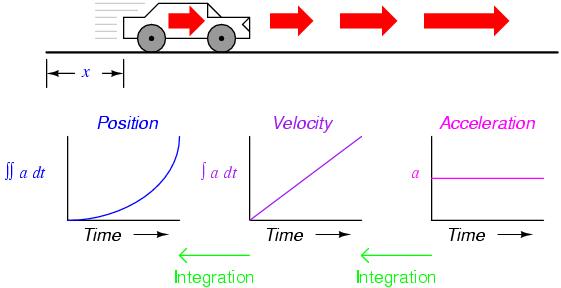
The WIKiD Tool algorithm provides a mathematical framework for analyzing dynamic data related to social interactions in a network and memorialized on a Blockchain. This example uses an analogy to the position / velocity / acceleration equations that some people may remember from their school days.
These types of relationships are important for measuring things like innovation. Ask any VC for a definition of Innovation and they’ll probably say “I’ll know it when I see it” or “it’s a good idea with an economic outcome”. Neither of these things are measurable until long after the innovation occurs which is not practical. However, if we could measure something that is closely related (correlates) with innovation, perhaps we could use that to measure the thing we can’t see.
A similar thing happens on Wall street – how do you measure consumer confidence? Financial analysts noticed that the price of some commodities track closely with consumer confidence so they use that as a proxy for the thing they cannot measure directly. This is called a derivative – something whose value is derived from the value of something else. Suppose we use the same idea to measure things like Wisdom, Innovation, Knowledge, Information, and Data (WIKiD)?
As engineers interact with each other to form transaction records, the blockchain records the chronological order of every event, so we can now correlate all events with respect to time. The connections that are made may be analyzed for both quantity and quality (magnitude and direction). We can now use common mathematical tools from finance and physics.
We have established that the blockchain records the time function for
all events to an immutable ledger. In order to represent vector
magnitude we’ll follow a well known analogy to the
displacement-velocity-acceleration formulas from physics and associated
Calculus.
WIKiD stands for:
(W) = Wisdom (I) = Innovation (K) = Knowledge (i) = information (D) = Data
Data: In general, we can define data as points
placed on such a coordinate system. Each point defines a position in
space and the time where an event is recorded. The distance between data
points can be called “displacement”, because of the relative distance
between the points. In the simplest sense, we can see that Data (D1) and Displacement (D2) share an analogy.
Information: When you draw a line connecting two points, or you draw a line approximating a cluster of points, the slope of that line on a graph provided information about the phenomenon under observation. Is it getting larger slowly? Is it getting smaller rapidly? In essence, the slope of the line represents the rate of change in displacement with respect to time and gives the observation its “velocity”.
This may be represented by the relationship simply stated as:
i = dD/dt
Information is proportional to the rate of change in the data with respect to time
It should be clear that we are defining ‘information’ as a derivative
of ‘data’. a derivative in physics is the same as a derivative in
finance, that is “something whose value is derived from the value of
something else” That said, we now proceed down the latter of
derivatives.
Knowledge: The analogy between velocity and
knowledge is intuitive. Knowledge is a phenomenon that may be modeled as
the derivative of ‘information’. Strictly speaking, the value of
knowledge is derived from the value of the information from which
knowledge was created. It is intuitive that one accumulates knowledge
over a long period of absorbing information and integral data. Education
is the process of absorbing information from a printed page or screen,
and combining that with other previously accumulated information to form
knowledge.
Hence, the following relationship holds and is simply stated as follows:
K = di/dt =d2D1/dt2
Knowledge is proportional to the rate of change of information with respect to time
Innovation: The analogy between acceleration and innovation is also intuitive but a little more difficult to put to words (that is why we use equations). Consider an child who is knowledgeable in riding a bicycle on pavement. Suppose that the child, for the first time, encounters sand on the pavement while also executing a sharp turn. During the ensuing deceleration, the child experiences a very high increase in knowledge about their environment within an extremely short period of time. In any case, the child is forced to innovate a solution. Likewise, the motocross racer is constantly innovating to adapt to the conditions of the track. You can read a book about riding bicycles, but none can adequately describe the moment when the child must create the experience anew.
For the fact of innovation, we provide the following relationship simply stated as follows:
I = dk/dt = d2i/dt2 =d3D/dt3
Innovation is proportional to the rate of change of knowledge with respect to time
Innovation Example: One of the gross errors that we make in business is due to the inability to differentiate an economic event from it’s constituent physical parts. The classic example is innovation; Venture Capitalists often describe innovation as a new idea that has an economic outcome. This is problematic because innovation is defined with one equation having two unknowns. This is mathematically impossible to solve, except by laborious and expensive iterations.
The rational (mathematical) approach would be to test and observe
high rates of change of knowledge in a community and use that as a proxy
to identify the presence of innovation (as defined above). After that,
the community may be tested for economic outcomes. Unfortunately,
I=dk/dt is not normally possible to observe in a hierarchical business
structure. However, when formatted and validated correctly, and applied
to a network organizational structure, then I=dk/dt can be represented
graphically and accurately identified even by a child.
Wisdom: When we think of wisdom, our minds conjure
the image of an elderly person with a lifetime of experiences behind
them. Somehow, our elders seem to be able to predict the outcome of a
series of actions before those actions take place. This is why we seek
wisdom to lead our organizations and institutions.
Consider the manager of a factory floor who has 30 years experience.
During those 30 years, they have seen many things succeed and many
things fail. In fact, their experience represent a statistically
significant sample of representative events that they have experienced
in the past. The wise manager is able to process new information with
old information to predict the probability that the new idea will yield
the desired results. The propensity for wisdom may be modeled as a time
function in a similar manner.
W = dI/dt = dK2/dt2 = d3i/dt3 = d4D/dt4
Wisdom is proportional to the rate of change of innovation with respect to time
In general we could say that Wisdom is the second derivative of
Knowledge and the fourth derivative of Data. Similarly, Innovation is
the first derivative of Knowledge and the second derivative of
information, and so on. In order to identify innovation, we would
measure high rates of change of knowledge. Wisdom would be proportional
to high rates of innovation, etc. The utility of these functions
should be apparent.
Conclusion
The WIKiD tools algorithm provides a set of relationships for what are now considered intangible assets that are integrated by a time function. The Blockchain provides the master schedule for the time function to be recorded, leaving us with a somewhat routine task of identifying rates of change in observable events.
After about 4 years of not posting to this site, I have decided to return to the original ideas that resulted in so much innovation in this space. For a quick review, the term “Ingenesist” is derived from the Latin word for Engineer – A Maker of Useful Things.
The TIP archives found here include almost 600 blog posts (site map) approaching 1/2 million words. You’ll find the original thesis for the international mobility of engineers under NAFTA between US, Canada, and Mexico. That project involved 6 universities, the California Board of Professional Engineers, The National Council of Examiners for Engineers and Surveyors, and the National Society of Professional Engineers – and with the cooperation and support of CETYS University, the Baja California State Government, and over 250 Engineers from Mexico who presented the US Engineering Board exams.
That work was further developed at the Boeing Commercial Aircraft Company and published at the Boeing Technical Excellence series of conferences by their Technical Fellowship. From this effort, TIP developed The Innovation Bank that would match most worthy knowledge surplus to most worthy knowledge deficit to form an internal market (network) for knowledge transfer. That work is memorialized in an old 2007 Patent Application
Later, TIP co-founded Social Flights – a ride sharing service for private jets. The innovation was our ability to predict most likely passengers and match them with most likely seats available on private aircraft. Supply and demand were both dynamic. Keep in mind that this was before Uber and we were acting within a highly regulated industry. Ultimately Social Flights was acquired.
TIP developed three key innovations:
The Value Game: An economic game where multiple self-interested agents must share a common asset. Their motivation and incentive would be to preserve the asset rather than consume the asset. This was supposed to simulate a sustainable economy such as what is desperately needed for our planet. The Value Game originated at Boeing and was tested with Social Flights and successfully deployed in several remodeling projects for condominium associations (shares asset communities)
The WIKiD Tools Algorithm. WIKiD Tools creates a mathematical relationship between (viewed backwards) Data, information, Knowledge, Innovation, and Wisdom. WIKiD tools is useful when you can’t measure something like innovation directly, you could measure a derivative such as the “rate of change in knowledge” as a proxy. In this way,the richness of Wisdom, Information, Knowledge, information, and Data can be more predictable.
Curiosumé is a combination of the words Curate and Resumé. The idea behind curiosumé is to convert the CV or Resumé to a form of code that can be overlaid on other information databases such as Wikipedia, Amazon ontology, even the Library of Congress. This allows us to measure intangible assets as they act in a community.
Then Came Blockchain:
We stopped publishing to The Ingenesist Project in 2016 in order to apply TIP innovations to emerging technologies such as Social Media, Blockchain, AI, etc. It appeared that the decentralization of the engineering profession would be an important step in achieving the original goals of sustainable global enterprise. During this time, I also started a small engineering consulting firm called CoEngineers, PLLC that served a traditional local market bringing engineering services to a retail clientele. CoEngineers, PLLC helped pay the bills while also serving as a sandbox for testing and developing TIP Innovations. Our first entry into blockchain was the creation of a token called Quant on the BitShares Blockchain.
SIBOS, NSPE Task Force, and National Association of Insurance Commisioners: Collectively each of these organizations represent the Banking Industry, The Insurance Industry, and the Engineering Profession. TIP published 3 whitepapers that became the basis for the next iteration. It was noted that each of these industries trade an invisible currency called Risk. It was found that TIP methodologies were better described by actuarial math (probabilities) rather than interest laden monetary metrics. This 3-way association became the genesis of the Insurance / Engineering Blockchain Consortium. This was later changed to the Integrated Engineering Blockchain Consortium or IEBC.
IEBC: Over the course of several years, IEBC was the umbrella organization for 150 engineers, scientists, and business persons who advanced the idea of a decentralized engineering network to mesh with the banking and insurance environments. IEBC published numerous seminal documents and spoke at dozens of industry conferences. The two main achievements were to publish a whitepaper with detailed specifications for a blockchain strategy that would accommodate all prior TIP innovations. The IEBC team built a prototype blockchain by cloning an existing successful chain and modifying it to suit MVP demonstration. IEBC ultimately ramped down for lack of funding. But everything we learned is now open for iteration.
Where to re-Start? TIP has always been a place where ideas are formed and implemented either by ourselves or by others. Many TIP Ideas survive to this day in the many hundreds of engineers and scientists who have participated in the conversations, the start-ups, the publications, lectures, and webinars over the last 15-20 years. We can see many past TIP contributors advancing in their careers, businesses, and leadership roles.
There is something that binds people to this network – it has to do with the underlying belief that Makers Of Useful Things are the cause, not the effect, of sound and sustainable economic activity. The flaw of market capitalism has the world operating in a mirror image of the economy that was supposed to happen. The solution is more about perception than it is about revolution.
My prior post “The Tale of Two Cities” demonstrates that the intangible social value conjured into existence by the bridge that connects two fair cities far exceeds the ‘tangible’ value of that bridge. Yet, only the tangible value of the bridge is accounted for on a balance sheet such as GDP.
The Conjuring of Intangible Values
This may seem trivial until you observe that people are paid for their intangible assets (knowledge, creativity, and engineering calculations) as a percentage of the far lower number while the bankers, government, and corporate interests compensate themselves as a percentage of the far higher number. The difference appears to be unaccounted for.
The Tail of Two Cities article concludes that the value that is conjured into existence by both the bridge and the fractional reserve system must be equal, by definition; otherwise the metaphorical breezeway that connects the two worlds would fall.
Bitcoin suffers from a similar curse as The Tail of Two Cities. The prevailing argument against the crypto-currency is that it has no intrinsic value. I have personally argued that a currency must represent human productivity intrinsically or else no other human would be willing to work (be productive) in exchange for it. An article by Paul Bohm “The Value Of Bitcoin is Decentralization” makes a good point that the intrinsic value of Bitcoin is based on the value conjured into existence by increased productivity to society by what can be accomplished with Bitcoin that otherwise would be impossible without Bitcoin.
So if the valuation of a bridge crossing the river and the valuation of Bitcoin crossing the broker both suffer the same curse that there is no accounting system for intangibles, wouldn’t it make sense to solve that problem first – i.e., measure into existence the intangible value of the Ingenesist – and then release those millions of human intentions (bridges and Crypto-currencies, not withstanding), into the system of trade? This is the problem that Curiosumé proposes to resolve.
I believe that we first need to solve the under-mining problem that there is no accounting system for intangible assets. Only then can there be intrinsic value in the conservation of those assets
… then maybe none of this would seem so mysterious.
Nobody cares if the congress implodes. People care about the institutions that keep the water clean, lights on, food fresh, streets safe, children educated, medical services delivered, etc.
Institutions are run by people and there is no practical benefit of government when their primary role is to abolish the institutions that people depend on. In effect, they abolish themselves.
For the last 5 years, since the 2008 train wreck, tens of thousands of start-ups and social media ventures have arisen in direct response to institutional failures.
When people don’t like where their taxes are spent, they reallocate their contributions elsewhere
When education funding gets slashed, new forms of education emerge.
When a currency inflates too fast, new forms on non-inflatable currency are deployed.
When corporation reject their social charter, new forms of production systems are created.
When jobs disappear, people reallocate their knowledge assets elsewhere
When the law favors the few, new justice emerge
…and it goes on and on…
Today, we have constructed a scaffolding and everyone is laying their innovations and social apps and collaboration tools on he scaffolding. When the output of one app becomes the input of another app, and so on, the new economy will integrate sufficiently to effectively bypass the governmental institution that is failing within it. At that point, a new economy will emerge.
The following list of social platforms was compiled by Bert-Ola Bergstrand from Social Capital Forum in this document. From my experience and observation – there must be millions of people across the globe thinking along these lines. People who would respond to a new way of organizing if a complete system were to emerge – or if the old system were to slowly evaporate.
TRY THIS: Please take a look through his list and visit several sites randomly and see what pops up. Now, try to envision the integration that I described above where the output of one platform becomes the input of the next platform, and so on. This is how the future will arrive. This is the next step that we must take together – integrate.
This is the final post of the Financial System Hack Series. Contrary to conventional wisdom, the currency is the last hack, not the first. Only after Zertify, Gamidox and Exoquant are established would it be possible to introduce a currency that could compete, if not hedge the dollar.
With Zertify we can estimate the probability that a collection of knowledge assets will be able to execute a business plan some time in the future.
With Gamidox, The Value Game is played where several communities interact around a shared asset such as a condominium, airplane, school, hospital, road, car, or any “product” that has socially redeeming value.
These interactions are measured such that we can assign “value” to the game with the Exoquant algorithm.
So taken together:
If we can predict the probability that the interactions carried out by communities of people (relative to a product) will have a known value in the future, we can represent it as a “cash flow” with a known volatility (risk). Now, combining many interactions carried out by many communities around many products with known volatilities, we can pool the predicted cash flows into one large diversified cash flow. Next, we can cut the large flow into “bonds”, which we can extrapolate to net present value and to fund the community activities. This very similar to the way that corporation form and raise money – except without the corporation. While banks continue to issue Debt Bonds, communities will issue Innovation Bonds in parallel
Here is the hack:
In the old days everyone carried gold around with them to engage in trade. Since gold was heavy, bankers let people keep the gold in their vaults and they wrote little chits that represented the gold. After a while, people just traded the chits and it was no longer necessary to convert back to gold with each transaction. Eventually, the gold standard was eliminated altogether and people just traded the paper that now represents their future productivity (debt), not necessarily gold.
The currency of abundance
Likewise, after a while it would no longer be necessary to convert the community currency into dollars. As the dollar slowly starts losing it’s value under the weight of the debt load people will just trade community currencies. All of these values are made visible and validated from Zertify, Gamidox, and Exoquant data.
The antigen will not be triggered because this is exactly the same way that corporations interact with banks to capitalizes and securitizes dollar debt, the difference is that we are capitalizing and securitizing community innovation by measuring data, information, knowledge, innovation, and wisdom. A currency of abundance can then replace the currency of scarcity.
Nothing Changes and everything changes
Corporations and government can continue activities to the degree that they produce socially redeeming value by simply purchasing innovation bonds from the people with their dollars – if they’ll accept them.
In the first post of this series, we identified the 5 components of a financial system and suggested that Zertify, Gamidox, and Exoquant would serve to simulate their functions in a parallel economy before ultimately being adopted completely.
In this post we will identify the hack on the Wall Street Financial instrument regime. Although exoquant is a bit technical, the basic hack is quite simple:
Everyone knows that money is created through the creation of debt.
Everyone also knows that debt is a promise to produce something more in the future.
Likewise:
Everyone also knows that innovations increase human productivity.
Everyone also knows that innovation is a promise to produce something more in the future.
Here’s the hack:
Therefore, a currency backed by debt and a currency backed by innovation are both backed by future productivity. As such, two currencies backed by the same underlying asset are fully convertible with each other. Water dissolves water and innovation dissolves debt.
Here is how the Wall Street algorithm works:
People produce stuff in exchange for money
Bankers do not care about money, they care about the rate of change of money over time. This is called the “interest” rate.
Stockholders do not care about interest rate, they care about the rate of change of interest rate over time, this is called growth rate.
Hedge fund managers do not care about growth rate, they care about the rate of change of growth rate over time, this is the margin on their bets; options, and derivatives, etc.
CDOs and other financial exotica become increasingly divorced from the fact that people produce stuff for money.
The Exoquant Analogy:
The value of information is derived from the rate of change of data over time
The value of knowledge is derived from the rate of change of information over time
The value of innovation is derived from the rate of change of knowledge over time
The value of wisdom is derived from the value of innovation over time.
In order to “see” innovation before it happens, all we need to do is identify and measure rates of change of information in communities…and so on. Technically, this is a derivative, i.e., something whose value is derived from the value of something else. All of these metrics can be seen quite readily in the Zertify, Gamidox data sets. Each is a “derivative” backed by the stuff that people produce rather than the fiction of debt. The ability to predict future productivity is superior with an innovation backed currency and therefore superior to debt forced productivity – often compared to slavery.
The Silver Bullet
Innovation is a magic word. The hack is true to the Wall Street math as well as American culture. Anyone running for public office would not attack the proposition of an innovation backed currency. Therefore, the hack will not trigger an antigen.
The next and final post, The Currency Hack, will formulate this innovation currency in more detail.
Gross Domestic Product (GDP) refers to the market value of all officially recognized final goods and services produced within a country in a given period. Simon Kuznets first developed the concept of the GDP for a US Congress report in 1934. He immediately said not to use it as a measure for welfare. He later elaborated:
“Distinctions must be kept in mind between quantity and quality of growth, between costs and returns, and between the short and long run. Goals for more growth should specify more growth of what and for what.”
Sheer Madness at best
Today, the concept of Gross Domestic Product is vastly flawed to the point where the tail now wags the dog. GDP now determines what we produce, who produces it, where it is produced, when and how it is produced. Further, GDP snuffs out vast amounts of intangible value simply because it cannot be measured as GDP.
Global Policy is not enough
Recently, The G-20 meetings resolved to a very interesting point; to redefine GDP by a new set of metrics. This will be a long hard journey if done solely in the political domain. However, if we can make a business case for it, the entrepreneurs will jump on board. Then, and only then, can the landscape change as rapidly and drastically as will be required to turn civilization around equitably and peacefully.
Corporate Policy is not enough
The irony is that those who perpetrate GDP metrics may be those who would benefit the most from dumping it. In the following article from FastCompany, How Intangible Corporate Culture Creates Tangible Profits, companies who learn to transform intangible assets to tangible value become more competitive over companies that do not. The article cites Southwest Airlines as the first airline to strip down all “tangible” amenities, yet they succeed by replacing them with intangible value such as superior customer experience.
Policy, Corporations, Culture and Entrepreneurs need to act as one:
Interestingly, the FastCompany article talks a great deal about culture. They also use the terms; “information, knowledge, innovation, and wisdom” liberally throughout the text. This is very inspiring to us at The Ingenesist Project because we use similar language to design and deploy business methods in industries as diverse as Aviation, Construction, and Philanthropy that readily convert between tangible and intangible value.
For Example:
The objective of Zertify is to replace the competitive incentives among communities and replace them with a knowledge inventory that matches mentors to protégé. Teachers and students do not compete, they collaborate in order to be successful.
The Value Game creates an environment where one acting in the best interest of their collaborator, acts in their own best interest of value creation.
Our Exoquant algorithm provides a direct relatedness between information, knowledge, innovation, and wisdom.
The New Value Movement
When we talk about the New Value Movement, we are trying to specify a new class of business methods that can literally “manufacture” the things that people actually need without any distinction between tangible and intangible. People need a game that they can win playing by the same set of rules. People need food as much as the need love – there is no walled garden of human needs, except the planet we share.
Then we can measure what people actually produce with it
The New Value Tool is a repetitive simulation of The Value Game (described here, here, and here) that may be used to determine in advance the true value that may be created when people interact with each other around a shared asset.
The Social Charter
This should not be too difficult to envision since The Value Game plays out daily in the modern corporation where workers acting in the best interest of the corporation (the shared asset) interact with each other in various departments to preserve the asset rather than consume the asset – this is how corporations create social value; through the employment of people and the social utility of their products.
Obviously, corporations that fail to fulfill their social charter likewise fail to sustain value creation in a community. Those that do, tend to thrive in the Internet Age. The objective of the New Value Platform is to enable communities to organize, as do corporations, except without the burden of corporate governance or the priorities of outside investors.
Drag, Drop, and Dream
The New Value Tool is simple to use; just drag and drop from the Zertify Personal Knowledge Inventory into The Value Game and see what the Exoquant dashboard tells you about your simulation. It may take some practice at first to see how to make the numbers move, but soon it will become intuitive which scenarios create lots of New Value – and will likely sustain themselves in practice. Scenarios that do not, will likely fail in a particular community and ought not be ventured to practice.
Community Algorithm
Exoquant provides a very simple algorithm relating the creation of data, information, knowledge, innovation and wisdom that govern the Value Game. However, the weighting of these elements is a component of the “fuzzy math” that entrepreneurs bring to the game. The empirical data resulting from the application becomes property of the players (community) as their “Secret Sauce” of value creation in their own uniquely optimum economic game.
On the path to a Social Currency
The New Value Tool May become an important system for analyzing existing ventures for optimum social value creation as well as predicting how collections of knowledge assets in a community can optimize their social value in collaboration with each other. Eventually, the predictability of the outcomes will improve while diversification of projects will eliminate risks such that a social currency can be capitalized and securitized.
The question that persist for many college and university administrators is what actions must they take to optimize all of their relationships in a manner that reinforces their own value to their community.
The Value Game is an ideal solution for this type of scenario (if you are unfamiliar with TVG, please visit this primer link). The first step is to identify the asset. The recent graduate is the university asset because they are the customer and the product being advanced. After all, the life worth of that graduate will reflect upon the institution that prepared them for professional service.
Next, we identify the players that will interact with that graduate over the course of their lives.
A* = The Graduate
The graduate will interact with their Alma Mater
The graduate will interact with their alumni association
The graduate will interact with Their broader community
The graduate will interact with corporations and entrepreneurs
Now, Let’s review each of the relationships and the economic incentives that drive them:
A-1: The graduate relies on the university reputation with players 1,2,3 as an extension of their own capabilities.
A-2: The graduate relies on the influence and success of prior graduates who hold an affinity towards each other in fraternal social networks.
A-3: The graduate will interact with their community for friendships, residency, recreation, and support.
A-4: The graduate will rely on strong and equitable employers / entrepreneur base where they may self-actualize as productive citizens.
Now, let’s review the relationships and incentives that each of the players has with each other:
1 – 2,3,4: The university has an interest in preserving the community because a motivated and educated workforce attracts opportunity far and wide in the form of business, travel, tourism and economic growth (Jacobs Externality).
2 – 1,3,4: Alumni seek to preserve the value of their alma mater because of the direct reflection upon their careers. It is in their best interest to support the university, it’s graduates, employers and the wider community.
3 – 1,2,4: The community relies on the university graduates and alumni to provide equitable and fair innovations that provide sustainable living standards.
4 – 1,2,3: Employers compete globally for talented, stable and engaged employees and service providers who are attracted foremost by a vibrant entrepreneurial economy and sustainable communities.
Data, information, knowledge, innovation, and wisdom
The Value Game is now played by university administrators who direct university facilities, influence, and resources to bringing at least 2 of these four groups together. Each time there is an interaction, the university will capture the data associated with the interaction. That data can be compiled to form information which gives the university administrator knowledge about what their next action must be. University feedback to the community will tell all of the players what interactions create the most social value upon which all players will innovate in their best interest.
As the game continues over time, the university gains the wisdom to understand the values of their assets and surrounding community. The community will act in the best interest of the other players as a means of acting in their own best interest (Social Capitalism).
Data is the ultimate shared asset
Over time, the University will become the physical “Search Engine” for data, information, knowledge, innovation, and wisdom in a community instead of just a vetting mechanism for book learned material. The University can now deploy this wisdom to their own internal programs and curricula as well as becoming an external reference source for government, industry, and economic development.
*(The University of New Haven is in no way affiliated with this post except I (the author) am a graduate of the UNH Engineering school (go Chargers!) and needed a realistic example that probably would not sue me – thanks guys)
Information is proportional to the rate of change of data with respect to time
Knowledge is proportional to the rate of change of information with respect to time
Innovation is proportional to the rate of change of knowledge with respect to time
Wisdom is proportional to the rate of change of innovation with respect to time
In clinical terms, this is called a “Differential Equation”
I always get a lot of questions about these. Most people’s eyes glaze over as their expression goes blank with far off images of high school Calculus class. Few people realize that these relationships are so common and so intuitive that we are all performing “Calculus” in many of their thoughts, words, actions, opinions, observations, and conclusions about the world around us.
But, just in case there is any doubt about the pervasiveness of differential equations in our culture and thinking, listen to the experts:
The idea here is that it’s OK to fail because this is how learning happens (rate of change of knowledge) but make sure you do it fast (with respect to time) because the objective is to innovate, not to not make mistakes.
Here she is referring to the proportionality component of creativity. The magnitude of the inspiration (rate of change of one’s knowledge of a matter) is greater than all other thinking moments, but it is constrained in time (with respect to time).
Marissa is talking about Wisdom. While innovation is proportional to the rate of change of knowledge, wisdom is proportional to the rate of change of innovation. The speed at which Google can innovate is how Google creates wisdom of what to do next.
***
Here are a few more. See if you can spot the differential equation:
“As people innovate and learn faster, they help generate new ways of performance improvements for everyone while progressing toward their own higher goals” – John Hagel, The Big Shift
Differential Equations are used to describe a vast array of phenomena in our physical universe.
These include the the forces of particles in motion, diffusion of medicine through cell walls, the decay of radioactive substances, and effects of gravity on bodies, weather, energy, chemical reactions, even the creation of money itself. It should not be a shock then that bankers, CEOs, politicians, and all “investors” are not actually concerned with money, they are concerned with the rate of change of money with respect to time.
The question now becomes, why would their NOT be an algorithm for human values of knowledge, innovation, and wisdom when there is an algorithm for everything else with respect to time.
There is a tiny flaw in Market Capitalism that can be easily corrected
Technological change must always precede economic growth; we are going about the process of globalization as if economic growth can precede technological change. We got it upside down, that’s all.
Anything that can be made by allocating scarce land, labor, and financial capital can also be made by allocating abundant social, creative, and intellectual capital.
For every dollar of tangible value, there is at least 100 dollars worth of ‘intangible’ value that is really just ‘invisible’.
The global debt is trivial in comparison to the invisible value that exists with no accounting system to represent it.
There should be no economic incentive for anyone to make anything other than what they are most talented, interested, and passionate about.
Nobody knows everything.
Everybody knows something they can teach any other person.
Students, by definition, hold an equity position in their teachers.
Therefore, teachers should hold an equity position in their students – this will fix a lot of things.
Nothing economic happens until two or more people get together and build something.
Competition is over rated.
Collaboration is under rated.
All monetary things are valuable but not all valuable things are monetary.
There is a perfectly legitimate market for everyone.
A new currency will be the last thing that happens, not the first.
You can’t eat Gold
Information is proportional to the rate of change of data with respect to time.
Knowledge is proportional to the rate of change of information with respect to time.
Innovation is proportional to the rate of change of knowledge with respect to time.
Wisdom is proportional to the rate of change of innovation with respect to time.
If you want to create wisdom, go increase the rate of change of innovation. If you want to create innovation, go increase the rate of change of knowledge, etc. Now, flip over the series 15-18 above. See, you’ll do just fine.
Money represents past, present, or future productivity – otherwise nobody would work for it (think about that ).
Therefore, a currency backed by debt and a currency backed by innovation would become the mother of all hedge funds.
Securitization is a miracle of scale if done correctly, a disaster of scale if not
Time is the only valid basis of a currency.
My singular objective and greatest aspiration is to make “intangible” value tangible. I am confident that my children – and yours – will know what to do next.
I recently responded to the following Question on a Facebook group:
How could a newly established university be designed today in order to be elite? Which features must be included, and which features can be left out?
Subquestion: “What would you include in all dimensions: desired faculty, desired student body, location, graduation, research and tenure requirements, institutional structure and purpose, among other things, and what features would you exclude that are currently prevalent at “elite” institutions such as the Ivy Leagues?”
***
My answer as follows:
Why not go farther, much farther. Teachers would not get paid. Instead, they would hold an equity position the future of their students. Sort of like an inverse pyramid scheme built on knowledge assets – teachers would collect a small % amount from many students and a smaller % amount from their many future students students, and so on (multiplying value instead of dividing value). This would attract a certain type of teacher as well as a certain type of student. It would also favor research and innovation since the promise of stagnant salaries are not attractive in this arrangement.
Why two or three subject minors? How about a 3 platform minors; one in social philosophies, a minor in creative arts, and a minor in sciences. Instead of a “degree” your education would be expressed as a string of code representing each unit of study to form your unique API. Your API would interface with the APIs of your colleagues and teachers such that an algorithm could predict the likelihood that a strategic combination of knowledge assets could execute a particular business plan. Such probabilities would be able to predict and associate future cash flows with such business plans. These cash flows could then be securitized into a financial instrument called an “innovation bond”.
Rich people, corporations, and governments would buy these bonds and the revenues would fund the school. Access to the bonds also provides access to the underlying assets – the world’s knowledge. They would be hugely valuable as a hedge agains a declining fiat currency because, like money, knowledge assets can be deployed to create the things people need. Soon, everyone would become a teacher and everyone will become a student in a new form of capitalism will emerge where factors of production are allocated as social, creative and intellectual capital.
***
There were several interesting responses to this question as well as comments to my response. Admittedly, I was riffing a bit with my response , but I’ll defend it as follows:
First, let us not mistake “money” for “value” as a so-called “equity position” can be denominated in either. Second, there are many examples in society that demonstrate my conclusion. Parents take an equity position in the future of their children, executives across America have a cadre of protege from whom they take an equity position in their careers, and Society accepts levies, and taxes, and buy bonds that fund public education so that future productive generations can support the elderly.
The miracle of capitalization and securitization have created extraordinary levels of prosperity on Earth compared to historic social structuring. The ability to capitalize and securitize knowledge assets (as opposed to classical land, labor, and capital) is likely the next economic paradigm…if not the only sustainable economic paradigm. I would suggest that current university system is the aberration, not my comment above.
Capitalism is characterized by the condition where individuals acting in their own best interest consequently act in the best interest of society. By contrast, Socialism is characterized by the condition where individuals acting in the best interest of society consequently act in their own best interest.
Who are the Socialist?
While America espouses a capitalist system of social organization, the jobs that Capitalists create are contained in corporations that operate much closer to the socialist model of community organization.
In a corporation, employees are motivated to act in the best interest of the corporation as a means to assure their own best interest. Resources allocation is channeled through ministers who are led by a benevolent dictator responding to the priorities of a family of stockholders. Tasks are segmented into units of equal pay for equal work. There are limited avenues to advancement. People cannot talk freely against their employer. It is acceptable practice to banish some people for the best interest of the collective.
First Amendment To The U.S. Counterintuition
The opposite holds for the OWS movement – some say the occupiers are socialist, however, the jobs that they create are Capitalist. There is no benevolent dictator or appointed ministers or hierarchy to allocate resources. Anyone can join and nobody gets sent to the gulag. Yet, everyone knows what to do like some kind of invisible hand that elevates an ideal. Most importantly, there are unlimited avenues for advancement.
The movement was peaceful.
Buildings did not fall. Mothers did not mourn the death of children. There was no volatility induced on the stock markets, the lawyers stayed in their offices, politicians were relatively unscathed. Those protestors who did suffer are now celebrated in the media, culture, art, music, Facebook, etc. In short, People acting in their own best interest were in fact acting in the best interest of society.
Reoccupy Wall Street
Now that the movement has been dispersed, and the 89% who still have jobs return to occupy their respective corners of Wall Street. The global narrative has changed for everything from warfare to environmental protection to income equality.
The products that emerge
Already, mobile apps now exceed CD/DVD sales. Mobile computing devices will replace PCs. Television sales are going down. Many of us now own our last internal combustion automobile. Social Media Applications are mimicking financial instruments with new systems for trade, exchanges, trust, influence, and value creation. Allocating social capital, creative capital, and intellectual capital rather than the now quaint but hopelessly static notions of land, labor, and fiat capital is producing real value.
Capitalism and socialism are simply two of many different forms of social organization. People are reorganizing.
Millions of people are looking for Jobs. Meanwhile, employers complain of a chronic “skills mismatch” that prevents them from hiring people or initiating new innovations.
When an engineer is laid off from an airplane manufacturer, a company like Starbucks has no idea what that person knows even though aircraft and milk steamers have a great deal in common from the perspective of the Engineer (both are pressure vessels subject to extreme environmental conditions).
The same is true for a marine engineer, and HVAC engineer, or an electrostatic coating machinery engineer. Each of these disciplines has far more in common than they have differences. However, if you compare the descriptions for any of these jobs, they sound like they all happen on different planets.
God forbid you are not an expert on MS Excel, which only takes a few hours for almost anyone to learn – yet not tagging that radio button can negate 20 years of experience that only 1% of people have the desire, discipline, and intellect to achieve.
The same holds true for many talents and professions. There are serious problems with the way that we discern the supply and demand for knowledge assets.
What is needed is an intermediate knowledge inventory in the commons that everyone can index to. So when an engineer tags “pressure vessels” the term registers into the resident ontology of all observers.
Why is this better?
Of course companies are trying to eliminate variance and risk by hiring a person who has been trained by someone else – preferable a direct competitor. On the other hand, the mantra of modern business is to innovate. Innovation does not happen by duplicating yesterday’s ideas. Mixing diverse combinations of knowledge assets, and not all common knowledge assets, accelerates the process of Innovation. Think of all the music that is yet to be created for lack of musicians to play the different instruments.
An intermediate knowledge inventory solves both problems by allowing companies to introduce diverse knowledge assets without introducing irrelevant knowledge assets. It also gives people far more mobility to pursue specialties that they are most talented and interested in. As such, the allocation of knowledge assets would improve to match supply of knowledge with the demand for knowledge in an innovation economy.
There is not a shortage or work, only a shortage of knowledge about knowledge.
Good ideas travel easily and far along trade routes. Ideas like irrigation, Apples, grapes and wine spread along the Silk Road. The paper and writing spread new ideas leading to increased literacy, the scrapping of old philosophy and the creation of new social orders. The printing press then led the way for today’s mighty publishing Industry. But don’t forget a simple fact, travel is the substrate of the next economic paradigm.
Ideas: A Chain with many Weak Links
Seth Godin wrote a wonderful article about the publishing industry called The Domino Effect. He observes that:
1. The middlemen (bookstores) have too much power to limit shelf space.
2.Authors are separated from their readers and don’t have the data to contact them directly.
3. Pricing is based static, slow, and largely irrelevant of content or any form of supply and demand which is of little benefit to the reader or the author.
4. Ideas from books travel much farther and faster than the book itself which does not translate into book sales.
Mr. Godin’s point is that given how important books are, the Chain has many weak links between the author and the audience. Publishing is due for an extraordinary disruption and Seth is going to change it with The Domino Project. But how many other industries suffer from the same weak-chain syndrome?
Travel: A Plane with many Weak Links
Well, if Books and Travel spreads ideas along the Silk Road, then they must have a lot of other things in common. If we apply Seth’s observations to the commercial airlines:
1. We see that Airports and airlines have tremendous power to limit gates, times, and availability of routes.
2. Airlines have no idea why they are carrying all those people around.
3. Pricing is static, segmented, slow, and has very little to do with the actual supply and demand for travel.
4. Travelers are transporting ideas which move faster and more broadly than the aircraft itself and which does not translate into more airline tickets sold.
Where ideas spread; value is created
What is so powerful about ideas? Most innovation gurus discount raw “ideas” as the useless drivel of idle minds. “Show me the money, not the ideas”, they bark. If ideas are not innovation, then what are they? If Ideas are not valuable, then what are they?
The Travel Economy
Travel technologies and applications are being sold for incredible sums of money. Every airline merger is big news and every geolocation application is huge business. Travel data is a lightening rod for everything from pricing to privacy. Social Media applications are getting that migration routes are an excellent marker for “value flow” and therefore, cash flow. Airline Travel is still the most favored mode political disruption because the links in the economic chain are so weak. Travel is serious business.
Every industry with weak links between production and end use are candidates for disruption in the great integration. Any idea that can strengthen the link in the chain between origin and the destination of an idea is a product of the great integration. The Social Value creation process and astonishing opportunity will happen at the weak links between origin and destination of any product or service.
***
(Editors note: The above post is #2 in a series [1], [2], [3], [4], [5] introducing The Value Game to a new class of business methods. The first real world application is Social Flights; a collaborative production / consumption game being deployed to the market. If this works, the new business method class will be generalized throughout the economy to catalyze the convertibility of social currency. Please join us at The Future of Money and Technology Summit in San Francisco on february 28th 2011 where we will unveil the work to the technology community)
In my opinion, The Future of Money and Technology Summit is among the most important conferences in America. FOM&T is not the usual parade of polished celebrities selling books, consulting, or seminars. Here you’ll find the people who work deep in the caldron of innovation enterprise bringing together some of the most important ideas in the world today.
The Moment is now
The challenges for the future are immense, the technologies unfolding before us are extraordinary, and the people on the front lines are visionaries. For better or worse, future generations will look back on several key moments that marked the beginning of a new era.
Last year I was deeply humbled by the quantity, quality and razor sharp intellect from the audience and the speaking panels alike. The panels were great, but the audience was just as awesome. Every question asked of the panelists was as profound and inspired as the panelists themselves. One common thread binds this conference like no other that I’ve attended: we’re all in it together. I consider myself privileged to be a participant in this event.
A Portrait of The Future
For me it seemed like 800 pieces to a huge jigsaw puzzle walking around finding their place in a yet unknown portrait of the future. Everyone has part of the answer and nobody has all the answers – this makes for an extraordinary collaborative learning environment and likely the best place to peer deep into the future.
I strongly recommend that anyone who engages in this conversation of the ‘future of money and technology’ in their work, research, blog, or start-up must attend this historic event. This is truly an example that the whole is far greater than the sum of the parts, and there are some great parts!
Fight your reservations with your reservation
The Future of Money and Technology Summit will be held on February 28th 2011 at the beautiful Hotel Kabuki at 1625 Post Street, San Francisco, CA. More details can be found here.