
The Game of Zero was developed in order to populate the knowledge inventory. The purpose of GOZ is to introduce a constraint to Curiosumé which produces an equal amount of supply and demand for knowledge assets. The reason for this is to incentivise the formation of a market between and among knowledge asset holders.
(The Game of Zero (GOZ) is a subset of The Value Game (TVG) which may be found by searching this site.)
In order for a player to advance in a Value Game, the claims that they make in forming their Curiosumé must be verified by another game player and registered as a combined transaction record on the Knowledge inventory.
In order to create a dynamic market of data, information, knowledge, innovation and Wisdom, each player must register as both surplus and deficit knowledge assets (teacher and students). A score of surplus (what one knows) must be balanced by a score of deficit, (what one wants to learn) in order for the player to create tokens.
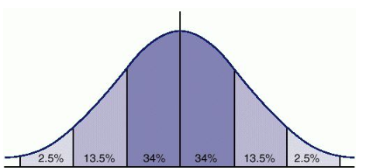
Introduction: As the name suggests, game mechanics are employed to move the production forward. Incentives consist of a combination of intrinsic motivations as well as financial compensation. A knowledge inventory is expressed from an ontology that brings context to interactions. The two-way flow of information is expressed as a simple bell-curve distribution for states of knowledge ranging from teacher (+1,+2,+3 Sigmas) to student (-1,-2,-3 Sigmas).
The Game of Zero gets its name from the only constraint that is applied: each participant MUST have a total score of ZERO.
Formation of Knowledge Inventory:
Ontology is a difficult topic to address universally because every company, institution, and every affinity group has their own specific means and methods for defining themselves in terms of ontology.
Example: the following is the Wikipedia Ontology:
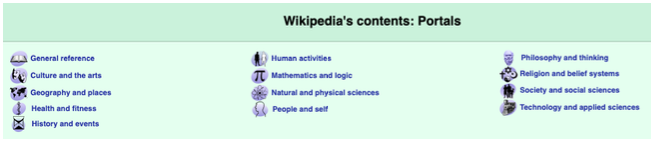
Generalized Knowledge Inventory:
| Top Level Wikipedia Categories | -3s | -2s | -1s | +1s | +2s | +3s |
| General Reference | X | |||||
| Culture and The Arts | X | |||||
| Geography and Places | X | |||||
| Health and Fitness | X | |||||
| History and Events | X | |||||
| Human Activity | X | |||||
| Mathematics and Logic | X | |||||
| Natural and Physical Sciences | X | |||||
| People and Self | X | |||||
| Philosophy and Thinking | X | |||||
| Religion and Belief Systems | X | |||||
| Society and Social Sciences | X | |||||
| Technology and Applied Sciences | X | |||||
| TOTAL = 0 | -3 | -6 | -2 | +4 | +4 | +3 |
| Absolute Value = 22 |
Claim your Intellectual Property:
- Earn Power by claiming your IP blocks.
- Increase your power by having each block validated by another participant.
- Surplus refers to knowledge that you offer to others
- Deficit refers to knowledge that you need from others
- Rank yourself as you fit among the community of your peers
- Positive and negative must balance at zero
- Adjustments can be made at any time
Important: Each of the above categories likewise have sub categories for which the same constraint holds. Below those categories may exist many more for which the constraint likewise holds.
Absolute Values in each category may be analyzed as well for business intelligence. The combined knowledge inventory will accumulate substantial value.
Implications for Merchandizing platform:
The Game of Zero provides a way for the participants to increase their “stake” in the system. By accumulation of Absolute Value, the participant increases their likelihood of gaining a more valuable position / winning a more valuable prize.
The network of participants can safely contact each other based on mutual interests of validating knowledge and information. One buyer may want to alert other buyers of a good product or service based on their unique identifiers.
There is no incentive to cheat – If I lie about my knowledge inventory, this is the equivalent of spamming myself.
There is no incentive to troll because any claims that are not validated by one or more participant of relevant profile can be ignored by the system.
Playing the Game of Zero
Most applications require a user to become familiar with a detailed set of rules that are necessary overhead for security (passwords), Identity (KYC/AML), terms of use, rules of engagements, limits and levers, means and methods, etc. Each requires a mental investment on the player as well as a resource overhead on the application.
Video games are taught with a simple objective and just allowing the user to play at level 1. Level 1 teaches the player the skills that they will need to be successful at level 2, which likewise prepares the player for level 3 and so forth.
The Knowledge Inventory: The Game of Zero requires that a player complete a detailed profile in order to accumulate “stake” in the community. The profile is anonymous which allows the player to use an avatar or any name that they choose. They can change their name at any time. They can delete a profile and start again. They can even maintain more than one profile. Each of these freedoms has consequences at higher states of play, but at the beginning the player is encouraged to experiment to find their place in the community. The system will allow them to do anything that they want except violate the rule of zero.
The player will quickly realize that the game interacts with them based on the inputs to their profile. If they create a frivolous profile, they will get frivolous results. If they provide meaningful inputs, they will get meaningful results. Once they realize how it works, they may abandon a profile at this early stage and create a new one. Penalty for this is that they will need to re-start the clock (like starting on square one). This is not a big penalty at the early stages, but at the later stages this will become a significant deterrent.
The more stake that a player holds, the greater the payout will be from the system. Payout may exist in many forms from prizes to targeted economic opportunities such as gigs, validations, contests, and paid product endorsements. The value of the economic opportunity increases at higher states of play.
Higher States of Play
The Game of Zero forces that player to maintain a net state of ZERO across the entire spectrum of ontology. At higher States of play the players may also need to validate their claims in order to increase their stake. If they claim to be a +2 Sigma Computer programmer, they will need to find another +2 programmer to validate their claim. If they balance their expertise with a -3 sigma desire to learn the game of tennis, they will need to validate their claim with a tennis partner. Other scenarios are possible depending on market forces.
The process of claims and validations builds social cohesion, community engagement, and value of the system. Failure to complete transactions or validate claims limits the benefit of game play and may eventually upset the balance of ZERO.
Each claim and validation becomes a permanent record cast in time and cannot be altered without a corresponding counterclaim, or deletion of the profile.
Network Effects
The next level of growth will include a transformation from a strict e-commerce site to a networked platform. The following features will be added.
- Branding
- Encourage communities to interact with each other
- Precision matching of “teachers” to “students” drives value creation
- Targeted incentives
- Formation of affinity groups and buying pools
- Managed by algorithm
If the system is trained to behave like a network, then a simple valuation component will be reflected by the square of the number of nodes multiplied by the quality of each interaction set equal to the current linear valuations.
Management will then use this relationship to drive policy that concentrates on two things: Increases the number of participants and increasing the depth and breadth of engagement among the members.
Conclusion
How a Value Network Works
In business and commerce, value networks are an example of an economic ecosystem. Each member relies on one another to foster growth and increase value. Value network members can consist of external members (e.g., customers) or internal members, such as research and development teams.
Value networks enhance innovation, social welfare, the environment, as well as many other areas. Weakness in one node can affect the entire network. For example, if a development team is weak, the production team has a harder time creating the product, which can leave a buyer waiting for their shipment.
History: The Game of Zero was first identified by the author in response to requirements for managing the Summer Intern program at The Boeing Company between the years 1998-2002. Later around 2005-2008 the system was studies for closing the knowledge gap at Boeing as well. The research showed great promise and some parts of the work have been applied by the company. Additional research and development was conducted through various companies and start-ups from 2008 until present. The Game of Zero was generalized from the Boeing Experiments in private follow-on research and development as described in Curiosumé and The Innovation Bank. Details of this history are outlined in the whitepaper.

