Nobel Economist Robert Solow calculated that 80% of economic growth is the result of advances in technology. This Makes sense. Technology makes us more productive.
However, GDP measures the products, not the producers. Engineers, Scientists, and Technologists are responsible for ideation, design, and implementation of new and improved technology.
Unfortunately, Engineers, Scientists and Technologists are classified as “intangibles” Intangibles are, in turn, classified as expenses to be minimized, not investment to be maximized.
Here’s the good news… 80% of the true global economy is simply hidden from view. Trillions upon trillions of dollars are sitting on the table waiting to be measured into existence. Can you see it?
The Ingenesist Project uses game theory, blockchain, and Artificial Intelligence to convert Intangible Assets into a tangible form.
Join The Ingenesist Project
Analysis
The purpose of this video is to synthesize the simplest interpretation of value and test that against prevailing economic principals. Engineers, scientists and technologists are treated as EXPENSES, let that sink in. If they are not assets, then they are LIABILITIES… full stop. This is a clear, present and vastly consequential flaw that must be addressed by someone somewhere.
Otherwise, if there is no institution willing or able to defend this flawed economic principal, then it is super-vulnerable to disruption. We need to maximize innovation, not minimize innovation. There needs to be a wholistic and systemic approach to solving problems in the world. We must head off global systemic risks. As clever and experienced as the VC community is, they cannot be expected to pick and choose winners and losers in the next economic paradigm.
There is far more ‘money to be made’ by shifting engineers, scientists, and technologists to the ASSET column of the global balance sheet.
A firefighter is worth millions of dollars per hour preserving lives and property… but only when there is a fire. A Fire Protection Engineer can design thousands of buildings that will never burn.
In the absence of a fire, the true value of the Scientists, Engineers, and Technologists is invisible. But the value of their economic contribution continues to persist.
What if we could measure the true value of intangible assets into present value existence. A massive new asset class would be unlocked.
The Ingenesist Project uses Game Theory, Blockchain, and Artificial Intelligence to convert intangible assets into tangible form, at scale. There is no shortage of money, only a shortage of imagination.
Join The Ingenesist Project
Analysis
The purpose of this video is to demonstrate how engineers, scientists, and technologists remove RISK from complex systems. Risk is directly correlated to “return” and, therefore, profits.
So what happens to all of that value that a single diligent engineer creates when they remove all of the risk? Is it paid to the engineer? no. Is it returned to the non-victims of the calamity averted? no. Is captured by the the banking system as some form of arbitrage? Yes, absolutely, yes.
This is the deep dark secrets of finance. Don’t let the engineers, scientists, and technologists know that they are paid 2-20% of what they are worth. They may want free stuff like healthcare, job security, or royalties, or else they’ll go build something else that pays better social dividends. Can’t have that.
Obviously the question becomes, what happens when there are no more engineers to eliminate risk? There is a tipping point and we are dangerously close to approaching it. These things are easy to measure, assess, and resolve but there needs to be an institution able to secure material facts and assert the economics of those facts.
What if there was a tiny and nearly imperceptible flaw in Market Capitalism that could be easily corrected? To do so would solve many of society’s most pressing needs without disrupting the institutions upon which we depend.
Technological change must always precede economic growth. We are going about the business of civilization as if economic growth must always precede technological change. It’s like driving a car while looking through a mirror. In other words, money is not the cause of innovation. Money is the result of innovation. The implications of this tiny flaw impacts everything from Climate Change and Social Equity to Venture Capital and Global Debt.
It started with classical economic theory. In the 1700’s economic inputs such as Land, Labor, and Capital were easy to measure. The products that resulted from these inputs were also easy to measure. However, in the 1700’s; social, creative, and intellectual inputs by humans were not so easy to measure. Accountants call them intangibles, but they are simply “invisibles”.
Today, this is an easier problem to solve. Ironically, technological Change has brought us new ways to measure intangible assets. All we need to do is convert them to a tangible form. The resulting economic growth will far exceed global debt because there is no such thing as “not enough money to innovate”. Together we can correct A Tiny Flaw
Join the Ingenesist Project.
Analysis
This is largely the initial video in the series and the first that we published. Attention should be drawn to the idea that maybe there is a tiny flaw that can be easily corrected. Instead of trying to solve every single problem that is strangling civilization as we know it, we could solve one single problem and the other problems will solve themselves.
The question becomes: are we too vested in our misery to even consider such a possibility? Are we so narcissistic to believe that our particular problem is the one that must be solved even if it worsens someone else’s problem? Are we all expecting the “other guy” to change and that will make your world work? Good luck with that.
The flaw is no tiny, so hidden, yet so obvious that it defies the imagination. All we need to do is measure ourselves differently. Who is stopping us from doing this? nobody. What law says we can’t do this? There is none. And if we do correct the flaw, who suffers? No one.
A Knowledge Inventory System; The Ingenesist Project
Have you ever wondered why the credits at the end of a movie are printed so small and scroll by so fast? The credits are not there for your benefit. The credits exist for the benefit of the movie industry.
Film production is a highly intellectual, creative, and social enterprise. In other words, Hollywood is denominated by knowledge assets. The rolling credits serve as a knowledge asset inventory system for all things needed to make the next movie.
Everything revolves around being on the credits or being known by people on the credits. This is how people find each other. The rolling credits make this possible. Not unlike a blockchain, in order to cheat the system, one must alter every instance of the celluloid reel or digital file.
Engineering, science and technology are also social, creative, and intellectual industries fueled by knowledge assets. Not unlike a blockchain, engineering processes are irreversible and immutable.
When we look at a sturdy bridge, or magnificent structure, or a brilliant piece of software, there is no easy way to find the people who are responsible for a specific element of that work. The Ingenesist Project uses game theory, blockchain, and Artificial Intelligence to create a knowledge asset inventory so that Engineers, Scientists, and Technologists can find each other.
Join The Ingenesist Project
Analysis
Engineering and science have long been compared to the Arts as a creative profession. The point of this video is to demonstrate how other creative professions deal with the intangibles gap. While the Hollywood system has its own set of pros and cons, the comparison is worthwhile. Notably, the arts often compensate creators with “royalties” while engineering, science, and technology most often pay hourly wages.
In addition, there are comparably fewer barriers, silos, or human resource management hurdles to navigate for artists. They don’t attempt to reduce a 4-dimensional performance down to a 2-dimensional CV/resumé. Instead, they can submit the 4D performance as their resumé. A great deal of efficiency is retained.
An Algorithm For Innovation; The Ingenesist Project
A useful definition allows people to identify, replicate, or measure the subject being defined. Yet the best definition we have for Innovation is basically, “You know it when you see it”.
How can we sustain our world if we cannot even define the sole instrument of change?
Have you ever had an epiphany? That ah-ha moment that comes from deep within… …when suddenly your knowledge about something grows exponentially within a very short period of time? Let’s call that “innovation”, where one large innovation is comprised of many smaller innovations.
In order to measure innovation, all you need to do is measure the rate of change of knowledge with respect to time. You don’t need Calculus to recognize this as an algorithm for innovation … but it helps.
If that idea doesn’t change the world, nothing will.
Join The Ingenesist Project
Analysis
Innovation is a great mystery that does not need to be. Everyone innovates – it is necessary for survival. Yet the magic and mystique of the innovator is a cultural phenomenon that forms the foundation of tech social status. Innovation is denominated in money – if you are not flush with cash, then you are not an innovator. Only VC can be innovators due to their ability to navigate financial markets. It almost seems that the more difficult it is to identify something, greater scarcity can be assigned to it. With greater scarcity come greater value. Again, when we become vested in our own misery, progress grinds to a halt.
This is all quite counter productive.
The problems of the future will require innovation, creation, new ideas, and vast execution at an astonishing scale. In order to achieve true economic sustainability, we need to a metric to denominate true value, not propped up scarcity value.
It is relatively easy to create and measure where high rates of change are occurring in a community or society. It is then relatively easy to observe what innovations take place as a result. This isn’t exactly a unicorn farm, but you probably can’t have a unicorn without these conditions in the first place. It is then only a matter of memorializing these conditions in a tangible form.
Innovation is not linear Modern civilization did not begin 10,000 years ago with 250 Trillion dollars sitting in a box somewhere in the desert.
Money was measured into existence as a function of the things that scientists, engineers, and technologists built. Innovations such as the wheel, wedge, and lever came long before the invention of International Trade Agreements Innovations in machinery, transportation and energy enabled advances in sanitation, healthcare, and computers
Yet, the wheel, wedge, and lever are more important and more widely applied than ever. Wouldn’t it make more sense if we developed a monetary system backed by the dividends of innovation rather than the gravity of debt?
The Ingenesist Project uses game theory, blockchain, and artificial intelligence to measure the true economic contribution of engineers, scientists, and technologists.
The Ingenesist Project Uses Game Theory, Blockchain, and Artificial Intelligence to convert intangible assets to a more tangible form.
Part One: Observe The game is based on a system of claims and validations among a population of players.
Part Two: Measure Blockchain acts like a giant datalogger that captures time-value data of game transactions.
Part 3: Predict The Percentile Search Engine predicts the likelihood various combinations of players would produce novel outcomes.
These three applications acting together create a virtuous circle that converts intangible assets into a more tangible form. Join The Ingenesist Project
Analysis
In almost every video, we make the statement that The Ingenesist Project uses game theory, blockchain, and AI to make intangible assets more tangible. This sounds pretty complicated, so how do you explain it in under a minute? The audience deserves to know how we intend to deliver on the promises that we are making.
The answer to this, and almost every engineering or scientific problem, boils down to making observations, measuring outcomes, and predicting future results. The same should be true here.
We’ve also stated that engineers remove risk from complex systems. Risk assessment follows a similar sequence; first you need to identify the risk exposure, then you need predict the likelihood it will manifest, then you need to measure the consequences of the event.
The game sets things into motion, the blockchain records the motion, and the AI reads the recorded motion and predicts the next point on the curve.
So what may seem like a very complicated and jargon laden geek storm is actually an extremely simply set of tasks that almost everyone already practices in the professional lives. Why reinvent the wheel?
To borrow from a famous quote: “Uber, owns no vehicles… Google and Facebook create no content… Alibaba holds no inventory… Airbnb owns no real estate….” But they have a combined value of almost 3 Trillion dollars. This is very interesting.
Whereas most companies are priced according to strict financial performance, Network platforms provide a virtual bridge that connects people to each other. They are priced proportional to the square of the number of human connections they serve.
This is known as Metcalfe’s Law of Network Value. If network platforms create a virtual bridge connecting people, why can’t we value real bridges using Metcalfe’s law? Why can’t we value roads, airports, buildings and all manner of engineering, scientific, and technological infrastructure as proportional to the connections they serve?
The Ingenesist project uses game theory, blockchain, and artificial Intelligence to convert intangible assets into a more tangible form. Join The Ingenesist Project
Analysis
We often say that Engineers, Scientists, and technologists need only to measure themselves differently in order to become “more tangible”. Most people’s eyes glaze over as if we’re living in some fantasy world. This video demonstrates that principal exactly as it happens with network platforms that are popping up everywhere around us. Really, we’re not making this up.
Metcalfe’s law arose from the telecommunications industry to measure the utility of telephone connections. The value of the network grows exponentially with the number of points in contact. Let’s start by saying that telephone networks themselves are a creation of engineering and scientific professions.
The engineering value of a bridge is equal to it’s replacement cost – so that’s what they pay engineers to create one. However, the economic value of the bridge includes every transaction, truck delivery, soccer game, doctor appointment, and math class that resulted from the ability for 10,000 people per day to cross the river.
Facebook, Google, Alibaba, AirBnB, et al, could not exist if they were valued according to their replacement cost. Imagine what amazing works of engineering, science, and innovation are non-existant today only because it is valued incorrectly.
As the saying goes, money makes the World go around. This may not be entirely true.
Where risk is high, the cost of money is high. Where risk is low, the cost of money is low. Engineers, scientists, and technologists specialize in removing risk from complex systems. So, why is there never enough money to mitigate the world’s most pressing risks?
Fortunately, all we need to do is reorganize engineers, scientists, and technologists and the money will surely follow
The Ingenesist Project uses game theory, blockchain technology, and Artificial Intelligence to reorganize the engineering and scientific professions.
This video poses a legitimate question. If there is money to be made by mitigating risk, why are Engineers, Scientists, and technologists classified as expenses (liabilities), and not assets on global balance sheets?
It’s amazing how vested we are in this staggering little flaw in market Capitalism.
Solving the problems of the future will require humans to innovate at an astonishing rate… … far greater than anything our existing economic system can support. In order to achieve this, there must be a fundamental shift in how knowledge assets are measured, curated, and exchanged.
Today, a traditional bank distributes money backed by your promise of FUTURE productivity. Innovation is also a promise backed by FUTURE productivity. Two currencies backed by the same underlying asset are readily convertible.
In the future, an Innovation Bank, would issue currency backed directly by the true value of innovation. All we need to do is measure ourselves differently.
The Ingenesist Project uses game theory, blockchain, and Artificial Intelligence to convert intangible assets into a more tangible form.
Join The Ingenesist Project
Analysis
The Innovation Standard is a reference to the Gold Standard or the Debt Standard, or the Oil Standard, etc. Whatever the standard, it needs to represent human productivity or else nobody would work in exchange for it (think about that for a sec).
The problems that face the world are global and they are systemic. That means that free markets technically don’t exist and the next thing that needs to be produced is the thing that society needs. Sure everyone wants a new Lambo, but it’s not very useful if the roads are too rough to drive it. Sure.Bitcoin is awesome but it’s contingent on a reliable energy grid. Sure, I love AI and much as the next geek but who’s going to read my content if they lack education to act on it?
Money as we know it just does not move fast enough. It does not represent the true productivity of Moms and Dads, soccer coaches, engineers, Scientists, teachers, and event organizers. Money needs to be produced as thenet sum of productive human behaviors. People know what problem needs to be solved next and if you give them the tools to fix things, they will.
Competition is one way of arriving at the optimal solution to a problem. Some call it the “Law of Nature”, survival of the fittest – where the final score can only be One to Zero. Unfortunately, in order to feed the winner, we must cultivate suitable losers. Evolution is slow and inefficient as a business optimization tool.
The laws of Nature provide infinitely more examples of collaboration than competition. Even if one player does not win today, their capacity to innovate remains to continuously improve the game for everyone later … if we let them.
The Ingenesist Project uses game theory, blockchain, and artificial intelligence to convert intangible assets into a more tangible form. Join The Ingenesist Project
Analysis:
This video acknowledges the value of competition as a solution optimization tool. So competition is not being called into question. However, a different problem involves preserving the knowledge, innovation, and wisdom that was created in the act of competition so that they can be developed in future or tangential problem solving environments.
Economics is the science of incentives which invariably invokes the discipline of game theory. we do have complete control over how a game is played, how players are preserved (or destroyed) and how equity is distributed. As such, we have complete control over the sustainability of the game which is ultimately in the best interest of everyone.
The conclusion is that a game which maximizes the health and welfare of the players ultimately maximizes the value of the game.
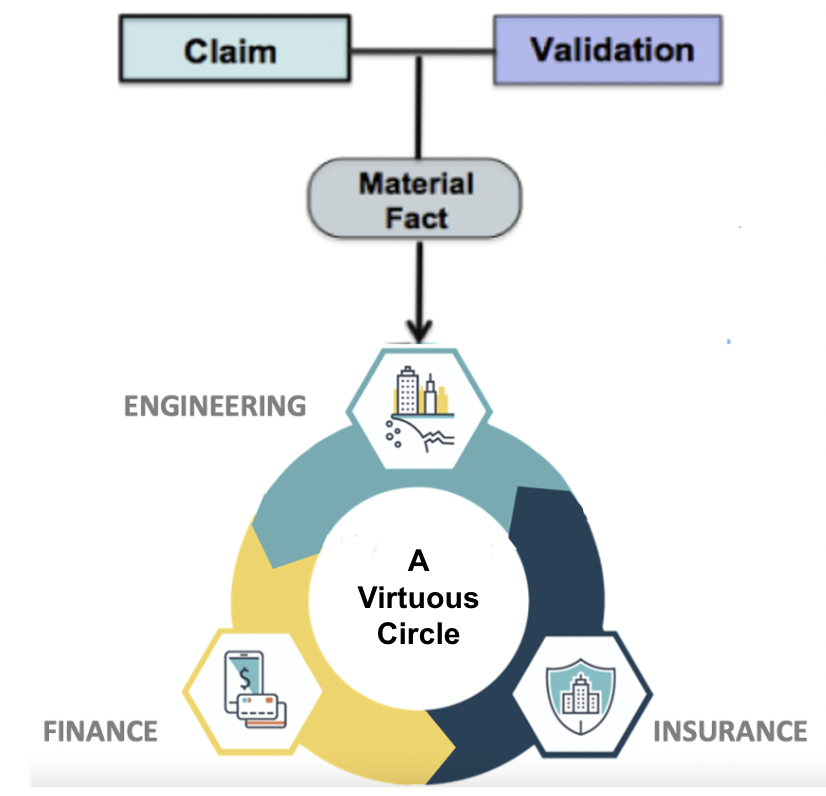
A bank won’t lend money to a project that is not insured. An insurance company will not underwrite a project that is not properly engineered. Engineering projects need to be financed to cover the cost of design and construction.
This is the Virtuous Circle of economic development. If any part of this cycle is broken, incomplete or corrupted, economic development fails.
Financial institutions simply issue paper receipts called “Money” to represent the actual things that engineers, scientists, and technologists create.
Money is, in fact, the intangible asset and engineering is the tangible asset! We’ve gotten it backwards.
When a virtuous circle reverses itself, it becomes a vicious circle. This is where we are today Fortunately, this is an easier problem to solve. The Ingenesist Project uses Game Theory, Blockchain, and Artificial Intelligence to reverse this vicious circle.
The purpose of this video is to introduce the big picture of how the Innovation Bank will integrate with existing financial networks to make the production cycle more efficient and more responsive to systemic risk.
The point of this video is to isolate the idea that our global economy is an interrelated system with 3 critical components that must be integrated and operating at peak efficiency in order for the economy to serve global citizens equitably.
The challenges of the future will require humans to innovate at an astonishing rate – far more rapidly than our current financial system can support. There is no way that Venture Capital – our current “best bet” – can respond to the speed, breadth, and depth of technological change.
The problem ahead is systemic risk. It is not possible for a collection of competing VC to pick the winners and the losers of the next economic paradigm. Unintentionally, the the VC system may cause more damage than good.
This idea is useful for when we introduce the game, blockchain, and AI components – the blockchain serves as a check valve that allows the virtuous circle to spin in only one direction. The game mechanics provide the energy to keep the virtuous circle spinning in the right direction, Augmented Intelligence will help identify what components of the system are operating optimally so that innovation can be applied correctly.
Decentralization is the rallying cry of the Blockchain Movement.
Few people realize that the Science, Engineering, and Technology professions are already decentralized. Unlike Banking and Finance, there are no all-powerful incumbents that must be vanquished. And the laws of Nature already apply to everyone.
Instead, Scientists, Engineers, and Technologists are contained by innumerable silos that have little to do with the Natural Laws We are segregated by jurisdiction, academia, ontology, corporations, politics, Trade Groups, Societies, international borders, and much more.
We represent 5% of the workforce but are responsible for 80% of economic growth. But collectively, we are weak, disorganized and powerless to prioritize the needs of our World. The only thing standing in our way, is ourselves. This is a much different problem than decentralization.
The Ingenesist Project uses Game Theory, Blockchain and Artificial Intelligence to remove the silos that divide us.
Analysis:
The single point of this video was to introduce the distinction that a centralized institution and a collection of compartmentalized institutions may have similar characteristics to the participants, but are not the same thing. The former is far more difficult to disrupt while the latter is entirely vulnerable to disruption. This represents a huge opportunity for those who can see the distinction.
This idea plays a central role in the execution of The Innovation Bank. Where many see a stone wall of resistance to change, there may actually exists a paper veneer.
Have you ever wondered why a soccer goal has a net? The purpose of the net is to provide a visual contrast so that 50,000 observers can immediately reach a consensus that something very important has happened.
After that, a digital token is awarded to the team that scored a goal. The digital token also secures valuable business intelligence like game strategy, player stats, league standings, revenue, and everything else.
However, the consensus is by far the most important part. With the consensus, a player can make a lot of money. Without the consensus, they are invisible. With the consensus, the community can invest in a new stadium. Without the consensus, we can only play at the school yard. With the consensus, the economy flourishes. Without the consensus, it fails.
Lots of crypto projects have these same pieces. But mostly, they are mixed up. The Ingenesist Project uses Game Theory, Blockchain, and Artificial Intelligence to secure community consensus.
Nobel Laureate Dr. Robert Solow calculated that 80% of economic growth can be attributed to technological change. This is the domain of engineers, scientists, and technologists. Accordingly, knowledge assets and their derivatives are not actually “intangible” but rather, they are simply invisible and unable to be measured directly. Like the proverbial “tip of the iceberg” the visible part of the economy is supported by the invisible assets below the surface.
True to form, emerging technology now offers us the ability to quantify this vast reservoir of value. We now have the opportunity to unlock an economy many times larger than the one we currently grapple with – the one in which there is “never enough money” to care for our planet and meet the needs of our civilization.
The Innovation Bank:
The Innovation Bank utilizes game mechanics, blockchain technology, and Artificial Intelligence to measure the natural interactions of engineers, scientists, and technologists within a simulation representing this hidden economy. Novel Financial Instruments may then represent this new value.
What is an Ingenesist?
A “Capitalist” is a person who uses money to invest in trade and industry for profit. An “Ingenesist” is a person who uses ingenuity to invest in trade and industry for profit. Both operate in tandem to arrive at optimal solutions to market requirements.
Join Us:
The Ingenesist Project comprises the collective vision, intellect, and creativity of more than 250 engineers, scientists, and technologists who have collaborated across various industries over the past 30 years as a non-profit research and governance organization.
The world is facing increasingly systemic challenges that pose significant threats to the global economy. The risk of a catastrophic event in one part of the world triggering widespread instability or collapse is now more imminent than ever. This isn’t merely a political issue; it’s an engineering challenge with the potential for a straightforward solution.
Insurance plays a vital role in ensuring the smooth operation of the global economy by providing a steady financial backbone for its builders, innovators, and participants. However, insurance can only function effectively when we have a clear understanding of known risks, their probabilities, and the consequences of potential losses. This underscores the critical importance of curating accurate and validated information about the physical state of the world.
The Domain of Engineering
Engineers, fundamentally, are professionals dedicated to reducing risk in complex systems. Interestingly, their analytical methods bear a striking resemblance to those employed by actuaries in the insurance industry. This highlights that the task of mitigating global systemic risk hinges on harnessing the expertise and observations of global engineers, scientists, and technologists.
The Age of Disinformation
In the information age, the business model predominantly revolves around collecting, manipulating, and leveraging information. Sadly, there are limited incentives to curate and verify accurate information. It’s worth noting that the absence of information can be as detrimental as false information, and both are considerably cheaper than producing and validating factual information. This is where the financial system faces significant challenges.
Converting Intangible Assets into Tangible Assets
One of the most pressing issues facing society today is the misallocation and confinement of engineers and scientists within various silos, such as academic institutions, political boundaries, corporate structures, arcane ontologies, and other factors unrelated to the natural laws equally affecting us all. Their knowledge is often categorized as “intangible assets,” not because it lacks substance, but because it’s challenging to quantify. Imagine if there were a quick and straightforward method to measure these intangible assets, transforming them into “tangible” assets, thereby creating a new asset class significantly more valuable than traditional assets.
A Straightforward Solution
The Ingenesist Project, a nonprofit professional network, is developing a platform designed to measure intangible assets and render them more tangible. Through the utilization of game theory, blockchain technology, and artificial intelligence, credible individuals make claims about the physical state of the world, which are then validated by other participants on the professional network. This dynamic process creates a validated and easily measurable large language graph, from which valuable AI business intelligence can be derived. Participants receive electronic tokens for contributing to this immutable native blockchain. The global insurance and finance industry can access this powerful network graph by purchasing tokens on a third-party clearinghouse from those seeking to sell them, with token value determined by market supply and demand.
Vast Consequences
By introducing this innovative framework, a new set of incentives can be established, making truth more profitable than fiction, at scale. The barriers that have traditionally separated engineers and scientists will no longer obstruct the curation of information essential to the insurance industry for crafting effective and socially impactful insurance products. This platform operates under a set of rules that apply equitably to all participants, eradicating corruption and unnecessary friction. Crucially, it provides the insurance industry with a reliable baseline of data to train AI models accurately, ensuring they operate in the right place, at the right time, and at the right price.
Visionary Leaders
The Ingenesist Project seeks sponsors to expedite the development of the “Innovation Bank.” Additionally, directorships and governance positions are available for visionary leaders in the insurance and engineering fields who recognize the potential of this groundbreaking initiative.
The Innovation Bank is a novel method of business related to the integration and capitalization of knowledge assets. The Innovation Bank is an application of game theory, actuarial math and a simple native “proof-of-stake” blockchain. The system aims to unify the global engineering and scientific disciplines by incentivizing individual practitioners to form knowledge asset networks among each other by producing claims and validations related to physical, measurable, and observable facts. Each claim and associated validation forms a node in a network for which each participant is awarded a cryptographic token memorializing earned stake (equity) in the system. A secure, validated, and decentralized knowledge repository and access management system is secured by a simple native blockchain. Revenue is generated through the liquidation of earned tokens on an external market to third parties seeking access to network metadata for business intelligence. The intrinsic value of the network grows as the number of participants increases. As participation increases, the quantity and quality of the transaction records also increases. Third-party buyers may include banks, insurance companies, and private enterprise.
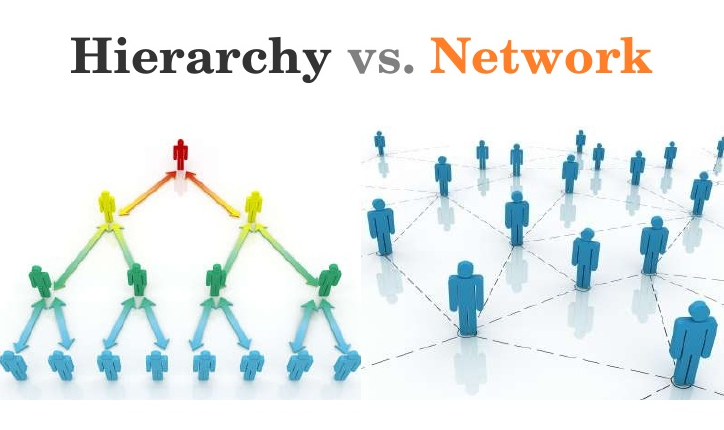
Modern platforms such as Google, Facebook, AirBnB, and others enjoy astronomical market valuations despite having comparatively less hard assets as legacy firms like Marriot, Boeing, T-Mobile, or Walmart. The difference may have something to do with their organizational structure.
Hierarchy: Since the dawn of the industrial revolution, centralized organizations comprised of multiple levels of management have been the proven means for allocating resources and minimizing risk. The value of such a construct is expressed in terms of market demand and sensitivity to risk as expressed by the Capital Asset Pricing Model (CAPM).
E(Ri) = Rf + Bi (E(Rm)-Rf)
Where:
E(Ri) = Expected rate of return on capital amount Rf = Risk free rate of return Bi = Sensitivity to market volatility (E(Rm) = Expected market return
The CAPM valuation model for an organization is dominated by market
risk multiplied by a firms sensitivity to market risk. CAPM valuations
are limited by market expectations and performance. CAPM is largely a
linear function except in the exclusive state where volatility is very
low and market returns are very high, such as monopoly or some duopoly
conditions.
Networks: A network is characterized by a collection of nodes (which may represent a switch, a computer, a sensor, or a person) and branches (wires, signals, instructions, or communications) connecting the nodes. The value of networks is a function of the total number of nodes and the total number of possible connections that can be completed between them multiplied by some coefficient of value for the quality of those connections.
Metcalfe’s law for Networks suggests that the theoretical value of a network will be proportional to the square of the number of nodes according to the following relationship.
Theoretical value is proportional to: n(n-1)/2
The Actual value would be related to the quality of the nodes, the
actual number of existing branches, and the net quality for the
transactions that transpire over the network. For example, the Value of
Facebook is estimated at:
VFacebook = (5.70 x 10⁻⁹) x n2
Where (n2) is the total number of users and (5.70 x 10⁻⁹), is an incredibly small number represents the average quantity and quality of nodes and branches between them. The Facebook platform objective is to maximize total number of connects AND maximize quantity AND quality of the interactions. For reference; MySpace still has 500M registered users giving it a valuable network, however, a low coefficient of interaction has eroded value of the platform substantially.
Self-regulation, fault-tolerance, and Management Autonomy
The network can make independent decisions: An engineer that is mis-allocated can quickly move closer to their area of interest and competence. Overlap between civil, mechanical, and electrical engineers can be managed appropriately. A corrupt engineer would have a very difficult time gaining access to a target without enduring a long and difficult road to establishing a transaction record that would permit sufficient isolation to the target to actually profit from the crime. It would be difficult to corrupt an engineer without knowing if they will be assigned to a target. It would be difficult to which engineer will be assigned to a potential target in advance of the attack. If an attack was attempted, it would be easy to identify who committed the crime. High impact targets may be covered with redundancy or a Byzantine proof. Obviously, Bots would be quickly and easily dispatched to the null condition.
Network Learning
Interactions between nodes will tend to optimize claims such that the value of the compensation received is proportional to the effort required to establish and verify a claim. This is a common practice in professional societies and certification bodies today. Further, strong professional communities with sufficient diversity, create conditions for rapidly and iterative teaching, learning, and collaboration leading to a high rates of innovation. Finally, professionals may reflect artistic or literary expertise or cite membership in multiple networks on their own valuation and the valuation of their team. Reflecting diverse interests from professional, recreational, and social opportunities will increase the individuals stake in the network and everyone’s stake in a team.
The Value of the Quantchain Network:
Economist Robert Solow received a nobel prize for his work in
estimating that 80% of economic growth can be attributed to
technological change. Said another way, for every 2 dollars spent on
engineering, society can expect 8 dollars returned to the economy. This
conveniently provided an average nodal value for engineers.
It is easy to count the number of engineers on the Quantchain,
therefore the only variable left is the ability to assess the value and
diversity of the interactions. Quantchain accomplishes this precise
objective in several ways:
The decentralization of engineers diversifies interactions
Dominant game strategy = cultivate a diverse community of claimants and validators approaching Dunbar Number.
The Percentile Search Engine assigns optimum probability vs. cost to all transactions.
Individual transactions and collective transactions are readily analyzed.
Engineering networks can be assembled and subdivided in any number of
ways and theoretical values may be assigned to them making the
valuation of teams, mergers of teams, divestiture of teams, or scenario
testing of any imaginable combination of teams, a quick and accurate
projection of network value.
I believe that it is important to make a distinction between New Currency and New Value. The potential for confusion is high but the implications of getting this wrong could be catastrophic.
The Storage and Exchange of Value
A currency is a social system designed to store and exchange value. Value is what people make when they do things together. Not so obvious is that a particular type of currency may not be very good for storing and exchanging a particular type of value. It is obvious that dollars may adequately representing the physical value of a computer, however, those same dollars may not be very good at representing the social value of a community using computer systems to interact with each other.
The New Value Movement:
From yesterday’s post: I have encountered hundreds of people developing social currencies with increasingly creative and constructive methods because their community is important to them. People are trying to solve the great puzzle of human division because their community is important to them. People are trying to resolve the constraints in natural resources and the limitations on our planet, because their community is important to them.
The New Value Movement is precisely that; a movement to articulate, store, and exchange New Value arising from technological advances and NOT adequately served by the existing financial system that enabled those technological advances in the first place.
The Total Value is the True Value
The idea of New Value is not to replace the current financial system, rather, the net total of value articulated by both systems exceeds the maximum value that traditional money alone is capable of processing. Convertibility between New Value and old currency will be conducted using a yet unknown New Currency that many now call “Social Currency”. When the total monetary system can articulate the total value of the Earth AND it’s human resources, only then can an organic set of priorities be delivered to a market.
The New Currency Movement:
On the other hand, the image of a New Currency often evokes the wholesale replacement of an old currency brought about by the collapse of a financial system, hyperinflation, destruction of the factors of production, the introduction of some unforeseen peril, induced volatility, political risk, nationalization, war, terrorism, famine, plague, pestilence, etc.,…Obviously, the differences between the two movements could not be more stark…
A Clear and Present dAnger
It is also apparent that the traditional financial system has become fragile and it must never be in the best interest of anyone to benefit from increasing this fragility. The Internet and emerging social media technologies have finally integrated the tools that people need to organize themselves into New Value economic developers. However, during the transition, individual people or groups will hold the power to both stabilize and destabilize.
The danger is that a new currency ideal may seek to benefit from the premature collapse of the old currency system. This is not creating new value, this is the transfer of value by the abuse of power against the very system that supports that power. This is precisely the flaw that the new value movement is trying to correct.
The New York Times published an article yesterday about derivative traders being controlled by 6 powerful banks whose influence serves to keep out competitors and decrease the transparency of transactions. What struck me was the graphics that the article used to demonstrate both the problem and the solution for derivative trading:
The Problem: Murky Market – no transparency
The Solution: Introducing a clearinghouse for transparency and correct pricing
The second diagram demonstrates how the introduction of a vetting mechanism inserted directly at the spot of least transparency greatly increases socially valuable attributes such as transparency, true pricing, reduced risk, open sourcing, elimination of conflicts of interest, and increased sustainability, etc – many of the attributes demanded by the new generation of activists seeking their place in the discussion that they struggle to understand. Hedge funds are indeed important tools for reducing volatility if, and only if, they don’t themselves introduce new risks.
The Value Game:
The second diagram looks a great deal like The Value Game developed by The Ingenesist Project for the monetizing social currency. By introducing a leveraged asset in the middle of a series of transactions, true value of the whole transaction system can be established eliminating volatility and reducing systemic risks. The Value Game works in a manner quite similar to a hedge instrument.
The Airplane Game:
The Airplane Game deployed by the new start-up called Social Flights, for example, introduces a jet airplane transaction as a clearinghouse for the balance of the transactions in the game of door-to-door travel. When all the players put their money down on a jet flight, they convert the financial currency to social currency, the true value of the transaction can be established when compared to an alternate market such as commercial airline, driving, train, etc. – not necessarily to dollars in the bank.
Financial Currency is a derivative of social currency
It is not surprising that social currency will become a hedge instrument for financial currency in markets. After all, nothing economic can happen until people get together to build something. Nothing of any significance can be built unless people exchange social currency. Only after all of that, can it be converted into money.
Intrinsic Banking
As such, every broker in every market can be replaced by a Social Value Game providing intrinsic banking services. Can you see it?
When I use the term “Innovation Bank”, people conjure up the image of a cheery place where anticipation reigns as starry eyed depositors arrange their intellectual property in neat cubby boxes, Patents fly like cash register receipts and companies troll the halls looking for a cure for their bottom line blues.
This is not exactly what we have in mind, nor is it too far off either. An innovation Bank is simply a knowledge inventory that contains knowledge assets that exists in the format of a financial instrument and can be deployed for the purposes of increasing productivity. In the process, it makes 10X more of itself every time it is deployed. It mints its own money.
The Innovation Banker
This is not much different than a financial bank. In fact, in the financial bank, everyone assumes the borrower has the knowledge to execute the business plan and the bank lends the money. Oh, by the way, the money makes more of itself 10X over (fractional reserve system) every time it is deployed.
With the innovation bank, everyone assumes the entrepreneur has the money to execute the plan, and the seek to borrow the knowledge. Other than that, they can be considered identical. The key is in the scope, depth, and format in which the knowledge assets live in a community as well as the ability to track and preserve the creation of new knowledge in a community. An innovation banker is a knowledge banker
A Virtuous Circle
Together with the financial banking, these two system engage in the dance of the virtuous circle of innovation enterprise. Apart, they collapse into the swirling cesspool of eternal debt and infinite interest (pun intended).
Today, I have been reading a lot of posts related to 9/11 and the terrible events of that day. The conversation lives. It is propagated in every direction and expressed in so many different ways once unimaginable from editorialized news.
My memory of 9/11 was quite personal; I was the customer engineering account manager at Boeing – my customer was United Airlines. I was fortunate to have worked with many UAL Pilots and Flight Attendants and their Unions; UAL lost 16 employees that day – I lost 16 friends.
I remember the anxiety in the aircraft business as the unspeakable was spoken, the impossible became possible, and the unreal became real. My own identity was defined by commercial air travel and the safety and comfort of people and families. The relationship between Boeing and UAL has always been profound; but the strain caused inside the industry was foreboding.
The fact that data could shift so rapidly called everything into question. Relationships diverged, people no longer knew how to process the information that was available. This gargantuan ‘outlier’ stained every single probability chart in existence – like a crater in a barren landscape. The only clarity could be found in shorter time segments, before 9/11, after 9/11… but not 9/11.
“Google News” was one of the first information aggregation devices and was developed in response to one news junky’s need to know, as soon as possible, what is happening in the world of such micro-timing. As the subsequent political and economic swings overshot every rational stabilizing mechanism such as ‘checks and balances’, or ‘market arbitrage’ forces, the rest of us sought quicker and better ways to stay in touch with the events of the world. This meant, quicker ways to stay in touch with each other.
Today, as 9 years of “new time” has been added to the risk equations, we can see the effects of radical cultural shifts; social priorities are gaining momentum over Wall Street priorities. While governments still wrestle with the old world order, a new one is forming in it’s place. This new world has the power to perform many of the functions of corporations and government. Can twitter catch terrorists? Can Facebook entries trigger community awareness? Can instant messaging deliver instant response? How many lives are saved by Social Media? I am not certain, but it is an important question to ask that age old question: Will good triumph over evil? or in economic terms; Is humanity self-correcting?
The convergence continues. The next paradigm of economic development will continue on the micro-time scale as FB communities hit neighborhoods, Linkedin communities hit local communities of practice, and Twitter news armies grow. Cooperation Capitalism will replace competitive Capitalism and social vetting will replace institutional surveillance. Finally, a productivity backed currency will replace debt backed currency. Bring it on.
Henry George was discredited for many ideas which are now emerging in with the increased economic influence of Social Media, social capitalism, trade of limited natural resources, and the trade of social currencies in reaction to the demise of financial currency.
The new film “The End of Poverty?” begins with the same question which Henry George asked in P&P:
Why does poverty become a deeper problem as a society becomes more prosperous?
While times and technology are far different than 110 years ago, early ideas are sometimes essential to peel back the complexity and look for the “truisms” that drive the Human Condition. Only then can we find both our common ground and our common direction.
[The following is a lose adaption from a 1993 article by Robert V. Andelson which can be found here with links dutifully provided by Stephen Nacci, 2010]:
The book describes basically taking Classical Econonomics and distorting it by
artifically merging land into capital, and distorting Classical economic thought
with NEO- Economic thought, and pushing this agenda through media and
institutions… over the last 100 years…
Henry George’s first book, Progress and Poverty: An inquiry into the cause of
industrial depressions and of increase of want with increase of wealth… The
Remedy was self-published in 1879. It went on to become the best-selling book ever on
political economy,* and in the 1880s and 1890s was said to be outsold only by
the Bible.
*Political economy is the science which deals with the natural laws governing the production and distribution of wealth and services.
He went on to write several other important books including Social Problems, The Land Question, The Condition of Labor, A Perplexed Philosopher, The Science of Political Economy, and (published posthumously) Protection or Free Trade, and a number of articles and speeches, including The Crime of Poverty, Ode to Liberty, Thou Shalt Not Steal, Thy Kingdom Come, Causes of Business Depression, and Justice the Object, Taxation the Means.
In 2006, Bob Drake* did a thought-by-thought updating into contemporary language of Progress and Poverty, which was published with the subtitle “Why there are recessions and poverty amid plenty — and what to do about it. Or, download and listen to Bob’s MP3 here
We hope you’ll explore Henry George’s answers — and his remedy. We are persuaded that the problem of poverty can only be solved through recognizing what George taught.
I don’t often run a full repost from other people on this blog, but this post by Seth Godin was just too rich to leave alone.
I have been posting a lot lately on the irony of social media devolving to spammers spamming spammers, especially the recent Twitter plan to charge advertisers for jumping to the front of the line by exploiting data provided voluntarily by the users (Twitter Me Elmo).
All of this tells us that Social Media is up against the ropes on the monetization plan. As a result it is starting to consume itself. This may be the first indication that the Dollar is NOT the currency of trade in the social media space, it’s a yet unnamed Social Currency. This definitely tells us that something new must happen soon.
Of course, The Ingenesist Project specifies an alternate financial system that can accommodate a social currency, but the lure of the almighty dollar remains strong enough to blind the choir itself and out-pitch the humble whisper new economic paradigm evangelists.
Anyway, here is Seth’s post in it’s entirety. Buy his books and read his blog, get his feed for daily email enlightenment. Seth, I apologize in advance for posting without your explicit permission…etc…just trying to “keep the convo rolling….”
*****
Cannibalism and spam
By Seth Godin:
So, these two cannibals are eating a clown, and one says to the other, “does this taste funny to you?”
We don’t often have conversations about cannibalism. We don’t trade recipes or talk about health issues. That’s because it’s off the table, not permitted, inconceivable.
Marketers should feel the same way about spamming people. Spamming them by email, by text or yes, by calling their cell phones with a robot, repeatedly, just because it’s cheap and because they can.
If anyone should know better, it’s the Word of Mouth Marketing Association. And yet, not only did they spam thousands of people by phone, they want us to “keep the convo rolling”. And when I spoke to their Executive Director, she had a hard time understanding that what they were doing was spam.
Spam is unanticipated, impersonal, irrelevant junk I don’t want to get. Not only that, it costs them less to send it than it takes me to figure out what it is and deal with it. That doesn’t scale. In fact, it destroys the medium.
Why would anyone join, pay their dues, go to their meetings or want to engage with an organization that’s willing to cross a line like this? Even once? (and then brag about it!) Maybe I’m getting cranky, but the relentless march of marketers into our lives is really getting to me.
In case you missed the first part of our show, the future of marketing is based on permission. It’s based on sending messages to people who want to get them, who choose to get them, who would miss you if you didn’t send them. It’s not easy and it’s not cheap to earn permission, but so what? This is my attention, not yours, and if you want to use it for a while, please earn the privilege.
PS If I ran Twitter, I’d build my new ad service about a socially acceptable way for corporate users to build large lists of followers, people who would give permission to get news and discounts and insights from advertisers. Twitter knows who likes what and they have permission from users to be a bridge between the user and those that might want to talk to them. That’s a powerful place to be.