INGENESIST PROJECT: Submission to the 10^100 Innovation Contest; www.project10tothe100.com
Single sentence:
The Ingenesist Project is an open source economic development program to induce the Innovation Economy utilizing Social Networks.
Tell us more (300 words)
The current financial system has reached the limits of its effectiveness. Interest on debt has exceeded the system’s ability to pay it off. But debt is simply a promissory note on future productivity – any caveman can tell us that the only way to increase productivity today is to innovate yesterday, not tomorrow.
In modern times, this means that the only way to sustainably create more money tomorrow is to innovate today. This is the flaw on Wall Street that Innovation Economics will correct.
Ingenesist has specified three simple web applications when applied to Social Networks, will allow Knowledge to become tangible outside of the organizational construct of a corporation, government, or academia. To develop these applications would unleash substantial innovation and wealth in society.
*The Knowledge Inventory
*The Percentile Search engine
*The Innovation Bank
Knowledge is an excellent tangible asset upon which to peg a currency – better than Gold, Silver, or Debt.
The factors of production for an Innovation Economy are Social Capital, Creative Capital, and Intellectual Capital. The knowledge Inventory classifies knowledge assets in social networks. The Percentile Search Engine assembles unique knowledge asset combinations and returns their probability of executing a given business objective. The Innovation Bank matches most worthy knowledge surplus to most worthy knowledge deficit. Finally, entrepreneurs elevate knowledge assets from lower states to higher states of productivity thereby creating wealth in communities.
By analogy; in the early 1800’s Eli Whitney performed a demonstration for members of Congress by disassembling 10 working muskets, scrambling the pieces and reassembled 10 working muskets. It may seem trivial to us today, but that simple feat astonished the world; it led to the industrial revolution, and unlocked a vast amount of innovation and wealth creation. Innovation Economics is the modern day equivalent.
What Problem does it solve (150 words)?
Technological change must always precede economy growth. We are going about the process of globalization as if economic growth can precede technological change. This simple reversal is the cause for much of what is unsustainable in the world today. Innovation Economics corrects this flaw.
To make knowledge assets tangible is the Holy Grail of financial accounting. The Ingenesist Project asserts that knowledge assets are not intangible, they are simply invisible – this is a much easier problem to solve. Innovation economics solves this problem.
True valuation of knowledge assets allows for direct capitalization of people and their social, creative, and intellectual capital. Networks of knowledge assets form a new type of corporation that is fault tolerant, self regulating, risk diversified, and responsive to social priorities. Wall Street becomes the steward instead of the master. The whole game changes.
If it becomes a reality, what happens (150 words)?
If Innovation Economics becomes a reality, Social Networks will become the driving force of economic growth because human knowledge (as social capital, creative capital, and intellectual capital) can be capitalized directly. Creative knowledge workers would benefit most initially.
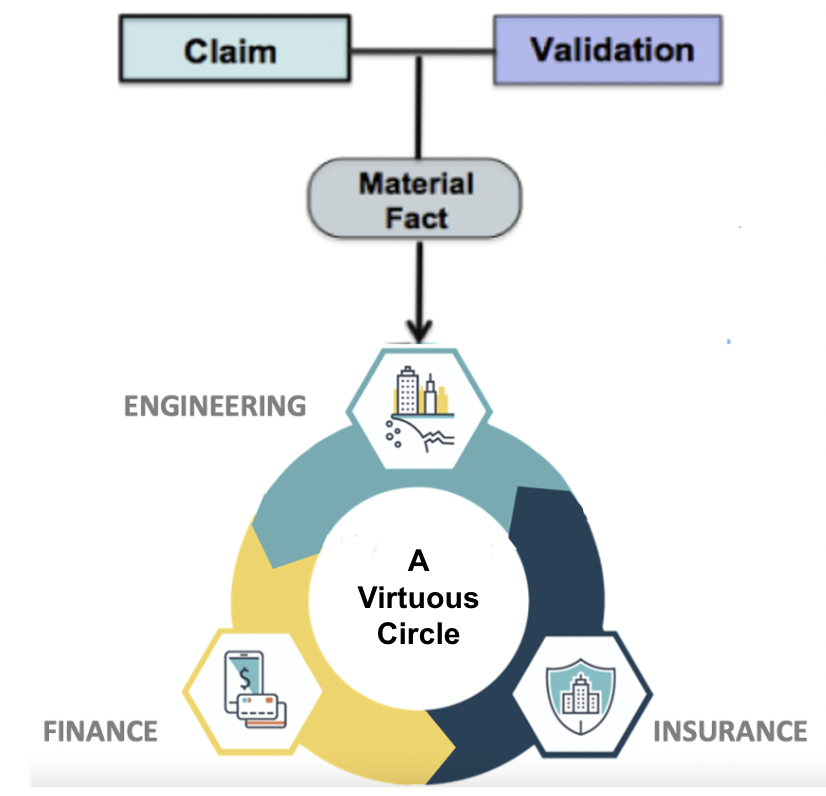
Eventually, publically traded Innovation Bonds backed by productivity gains will replace venture capital at vastly reduced risk and cost thereby unleashing an extraordinary amount of primary and tangential innovation creating a virtuous circle.
Areas of low productivity, such as poor communities and under-privileged populations will become targets for highest returns on innovation applications. Millions of new-to-the-world businesses will emerge and nearly all existing businesses will become more efficient where human knowledge is tangible and free to assemble itself in infinite, diverse, and strategic combinations.
If done correctly, eventually most people on Earth would benefit by freedom from the shackles of debt economics.
What are the initial steps to make it happen (150 words)?
Phase 1: The initial steps are: publish our research to a wider audience, prosecute our patent application (USPTO: 20070226361), release it to public property, and begin receiving public input.
Phase 2: Publish several animated videos which describe step-by-step the role that Social Networks must play to induce the Innovation Economy. Collect more input.
Phase 3: Create an open source development platform where ideas can be collected from the global community on how to develop the three web applications specified herein.
Phase 4: Develop and release common architecture web applications for The Knowledge Inventory, The Percentile Search Engine, and The Innovation Bank.
Phase 5: Exist indefinitely as an NGO to keep the game fair and build out emerging opportunities as needed.
What is the optimal Outcome and how is it measured (150 words)?
The intended outcome is for the innovation economy to arise from the knowledge economy as the next level of economic development. The optimal result would be an improved wider distribution of wealth and the transfer of corporate prioritization to communities regarding what gets innovated and what does not. Or likewise, which existing markets dynamics are disrupted and which are not. The optimal outcome would be the emergence of sustainable enterprise over forest-to-dump consumerism.
Metrics are inherent to the algorithm of the Percentile Search Engine as follows: innovation is proportional to the rate of change of knowledge with respect to time and knowledge is proportional to the rate of change of information with respect to time. Differential Calculus is the mathematical tool used to monitor all performance indicators of this system. In fact, all of the analytical methods of finance similarly apply to knowledge assets, by design.